
Selecting pipeline steel isn’t simply about choosing the right grade. A pipe that meets the chemical and mechanical requirements of API 5L may still fail if it cannot resist brittle fracture or hydrogen-related cracking under actual service conditions.
That’s why API 5L Pipeline Testing goes beyond tensile strength and yield strength. For transmission pipelines, especially those carrying sour gas or operating in low-temperature environments, tests such as Drop Weight Tear Test (DWTT), Hydrogen Induced Cracking (HIC), and Sulfide Stress Cracking (SSCC) help verify whether the steel can withstand real operating conditions.
Table of Contents
What Is API 5L Pipeline Testing and Why Does It Matter?
API 5L Pipeline Testing is the process of verifying that line pipe complies with mechanical, metallurgical, and environmental performance requirements before installation.
While API 5L defines chemical composition, dimensional tolerances, and mechanical properties, many oil and gas projects require additional qualification tests based on operating conditions.
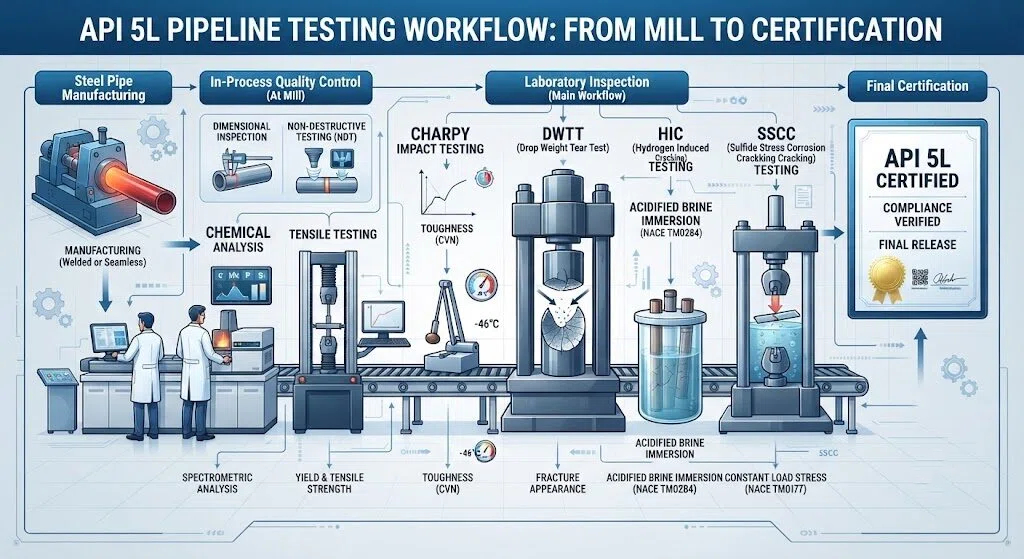
Typical verification includes:
- Chemical composition analysis
- Tensile testing
- Charpy impact testing
- Non-destructive testing (NDT)
- DWTT fracture toughness testing
- HIC testing for pipeline steel
- SSCC testing for API 5L steel
For pipelines transporting natural gas, crude oil, or sour media, these additional tests provide confidence that the material can resist fracture propagation and hydrogen damage.
Why Do Many Projects Specify PSL2 Instead of PSL1?
One of the most common questions from buyers is whether PSL1 material is sufficient.
The answer depends on the service environment.
PSL1 is intended for general pipeline applications, while PSL2 introduces tighter controls on manufacturing, inspection, and testing.
| Requirement | PSL1 | PSL2 |
|---|---|---|
| Chemical composition | Standard limits | Stricter limits |
| Impact toughness | Limited | Required for many grades |
| NDT requirements | Basic | More comprehensive |
| Traceability | Standard | Enhanced |
| Additional qualification tests | Project dependent | Frequently required |
For high-pressure transmission pipelines or offshore projects, PSL2 is often specified because it provides better confidence in material consistency and fracture performance.
How Does DWTT Testing Measure Pipeline Steel Fracture Resistance?
Strength alone does not determine whether a pipeline is safe.
When pipelines operate under high internal pressure, a small defect can propagate rapidly if the steel lacks sufficient fracture toughness.
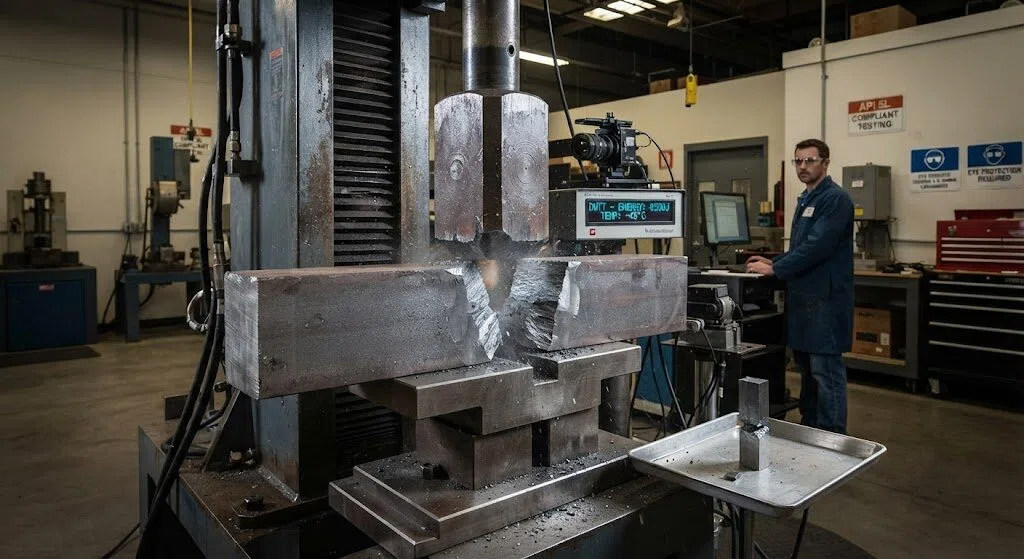
This is where the Drop Weight Tear Test (DWTT) becomes important.
Unlike a standard Charpy impact test, DWTT evaluates how a crack propagates through a full-thickness specimen after impact.
The test helps engineers determine whether the fracture behavior is primarily:
- Ductile fracture
- Brittle fracture
- Mixed fracture
A ductile fracture absorbs more energy before failure, making crack propagation less likely over long distances.
This is particularly important for:
- High-pressure gas transmission pipelines
- Arctic pipelines
- Long-distance oil pipelines
- Large-diameter line pipe
The test method is standardized under ASTM E436, which specifies procedures for evaluating fracture behavior using drop-weight impact equipment.
Why Isn’t Charpy Impact Testing Enough?
Many buyers assume Charpy impact values fully represent pipeline toughness.
Not exactly.
Charpy testing measures the energy absorbed by a small specimen.
DWTT evaluates fracture propagation behavior in a much larger specimen that more closely represents actual pipeline conditions.
For modern high-strength API 5L grades such as X65, X70, and X80, many project specifications use both tests because they measure different aspects of toughness.
| Test | Primary Purpose |
|---|---|
| Charpy Impact Test | Material toughness at specific temperatures |
| DWTT | Crack propagation resistance in pipeline steel |
Using both provides a more complete picture of fracture performance.
Why Are HIC and SSCC Tests Essential for Sour Service Pipelines?
Mechanical properties alone cannot predict how steel behaves in environments containing hydrogen sulfide (H₂S).
When pipelines transport sour crude oil or sour natural gas, hydrogen generated by corrosion reactions can enter the steel and cause internal damage.
For this reason, pipeline steel testing services for sour service projects often include both HIC testing for pipeline steel and SSCC testing for API 5L steel.
Although these tests are frequently mentioned together, they evaluate different failure mechanisms and should not be considered interchangeable.
According to ISO 15156 (Petroleum and natural gas industries — Materials for use in H₂S-containing environments), selecting materials for sour service requires evaluating the risk of hydrogen-assisted cracking under actual operating conditions.
HIC vs SSCC: What Is the Difference in Pipeline Steel Testing?
Although both tests evaluate hydrogen-related damage, they simulate different service conditions and failure mechanisms.
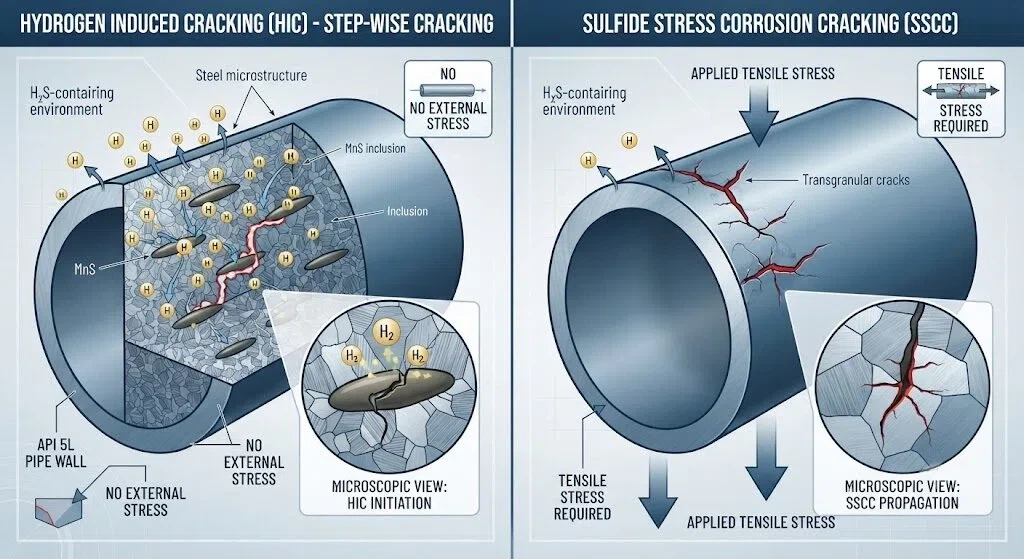
Hydrogen Induced Cracking (HIC) occurs when atomic hydrogen diffuses into the steel and accumulates around inclusions or segregation bands. Cracks can form without any external load.
Sulfide Stress Cracking (SSCC) requires two factors at the same time: exposure to an H₂S environment and sustained tensile stress. A material may pass HIC testing but still fail SSCC testing if stress levels are high.
| Test | HIC | SSCC |
|---|---|---|
| Main purpose | Evaluate resistance to internal hydrogen cracking | Evaluate cracking under tensile stress in sour environments |
| External stress required | No | Yes |
| Typical standard | NACE TM0284 | NACE TM0177 |
| Typical applications | Sour oil, sour gas pipelines | High-stress pipeline components, pressure equipment |
For projects involving wet H₂S service, engineers often require both tests because they complement rather than replace each other.
The Association for Materials Protection and Performance (AMPP) explains that hydrogen-related cracking remains one of the primary material risks in sour service environments.
How Are HIC and SSCC Tests Performed?
Understanding the test procedure helps buyers interpret laboratory reports instead of simply checking whether the result says “Pass.”
HIC TestingHIC
Typical steps include:
1.Machine specimens from the pipeline steel.
2.Immerse specimens in a standardized H₂S test solution.
3.Expose them for the specified duration.
4.Section the samples and examine internal cracks under a microscope.
5.Calculate:
- Crack Length Ratio (CLR)
- Crack Thickness Ratio (CTR)
- Crack Sensitivity Ratio (CSR)
Lower values generally indicate better resistance to hydrogen-induced cracking.
SSCC TestingSSCC
SSCC follows a different approach.
The specimen is subjected to a constant tensile load while exposed to an H₂S-containing environment.
Inspectors monitor whether cracking develops during the exposure period.
Unlike HIC, SSCC evaluates the combined effect of:
- hydrogen diffusion
- applied stress
- environmental exposure
These results are especially important for high-strength API 5L grades used in demanding oil and gas applications.
For readers unfamiliar with hydrogen embrittlement, the technical explanation provided by Wikipedia offers a useful overview of how hydrogen weakens metallic materials before cracking occurs:
What Should Buyers Check in an API 5L Pipeline Testing Report?
A complete testing report should do more than list mechanical properties.
Before approving pipeline steel, review the following:
- Applicable standards (API 5L, ASTM, ISO, or NACE/AMPP)
- Steel grade and PSL level
- Heat number and traceability
- Sampling location
- Test temperature
- Acceptance criteria
- Laboratory accreditation
- Complete fracture or cracking observations
If the project specifies sour service or low-temperature operation, confirm that DWTT, HIC, or SSCC results are included rather than assuming standard tensile tests are sufficient.
Why Does Third-Party Testing Matter?
Independent testing provides an additional level of confidence when pipeline materials will be used in critical infrastructure.
Many EPC contractors and pipeline operators require reports from accredited laboratories because the results can influence material acceptance, project compliance, and long-term operational safety.
For buyers comparing pipeline steel testing services, the laboratory’s capability, equipment, and experience with API 5L qualification can be just as important as the test itself.
Conclusion
Successful API 5L Pipeline Testing is not about completing a checklist of laboratory procedures. It is about confirming that pipeline steel can withstand the specific conditions it will encounter in service.
Mechanical tests verify strength, but DWTT demonstrates fracture resistance, while HIC and SSCC reveal how the material responds to hydrogen and sour environments. Together, these tests provide a more complete assessment of pipeline reliability than strength values alone.
For buyers evaluating API 5L pipeline steel, reviewing the full testing package—including fracture toughness, hydrogen cracking resistance, and report traceability—helps reduce technical risk before installation and supports safer long-term pipeline operation.
FAQ
Is DWTT mandatory for every API 5L pipe?
No. DWTT is typically required only when specified by the project or for higher-grade PSL2 pipelines where fracture propagation resistance is critical.
What does HIC testing detect?
HIC testing measures whether hydrogen entering the steel causes internal cracking in sour service environments.
Can a pipe pass HIC testing but fail SSCC testing?
Yes. HIC evaluates hydrogen damage without external stress, while SSCC evaluates cracking under sustained tensile stress.
Why are PSL2 pipes tested more extensively than PSL1?
PSL2 includes tighter requirements for chemical composition, toughness, inspection, and traceability, making it suitable for more demanding pipeline applications.
Which industries commonly require HIC and SSCC testing?
Oil and gas transmission, offshore platforms, petrochemical facilities, and any project involving H₂S-containing media.