
An induction-hardened spline shatters during its first cyclic axial load test. The purchasing sheet confirms the raw material was standard C45 grade, and the surface hardness gauge read 50 HRC. Yet, the failure still occurred. In heavy industrial manufacturing, this specific mode of catastrophic failure almost always points to a skipped or poorly executed thermal refinement phase at the forge. Before raw billets touch your lathe chucks, demanding a documented AISI 1045 Normalizing Test is the only mechanical guarantee that the internal microstructure is actually ready for heavy machining and localized hardening.
Table of Contents
What Causes Soft Spots on Induction Hardened Shafts?
Medium carbon steels require uniform carbon distribution to respond predictably to heat. When a raw steel billet is drop-forged, the extreme localized heat and uneven cooling rates force the carbon atoms into coarse, erratic formations known as Widmanstätten structures.
If a forge supplies you with these parts “as-forged,” your CNC tooling will hit unpredictable hard zones, shattering carbide inserts. Worse, when you send that machined part for induction hardening, the coarse grain matrix prevents the rapid formation of martensite. You end up with localized “soft spots”—areas on the journal bearing surface that will gall and seize under friction.
According to the metallurgical definitions maintained in the ScienceDirect database regarding the Widmanstätten structure, this coarse, needle-like formation severely drastically lowers the impact toughness of medium-carbon alloys. The only way to erase this hazardous structure is by heating the steel above its Ac3 critical temperature (roughly 850°C for this specific grade), holding it until full austenitization occurs, and cooling it in still air.
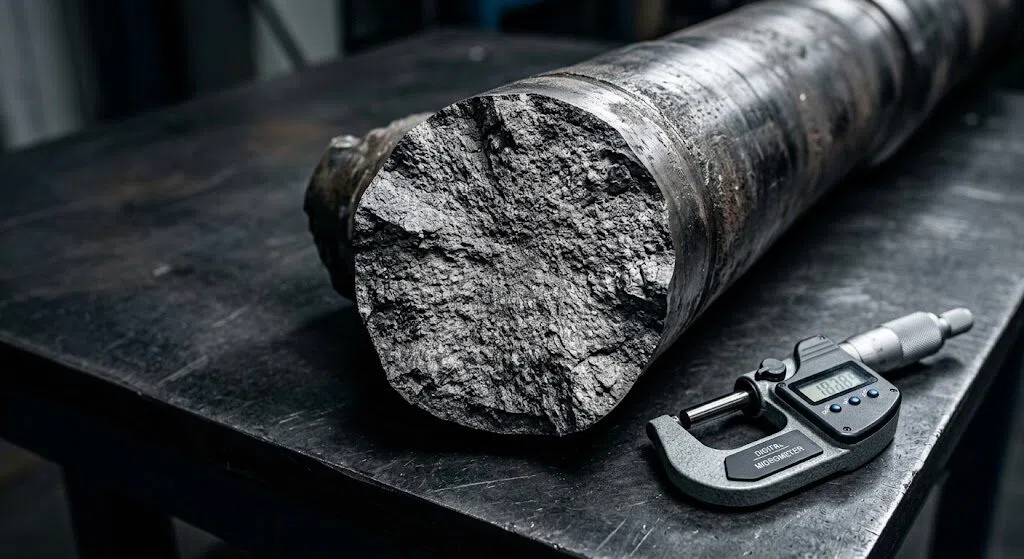
Evaluating Grain Refinement in an AISI 1045 Normalizing Test
A visual inspection of the steel tells you nothing. A standard Rockwell hardness punch only tells you the resistance of the outer 0.1mm. To verify that a batch of connecting rods can survive engine combustion cycles, a third-party laboratory must perform a destructive metallographic audit.
The laboratory cuts a cross-section of the sample, polishes it to a mirror finish, and etches it with a Nital solution (nitric acid and alcohol). Under an optical microscope at 100x to 400x magnification, the technician evaluates the ratio and distribution of ferrite (the soft iron phase) and pearlite (the hard, carbon-rich phase).
A passing audit reveals a tight, uniformly distributed matrix. If the Wikipedia index on Pearlite banding is referenced, you will see that severe banding—where ferrite and pearlite form distinct parallel lines rather than a homogenous mix—is a direct indicator that the cooling rate during the normalization process was poorly controlled. Severely banded steel will invariably warp out of tolerance during final heat treatment.
Why Visual Metallography Outperforms Surface Checking
During the extreme heat of the forging and normalizing process, ambient oxygen reacts with the carbon on the surface of the steel. This reaction literally burns the carbon out of the metal’s outer layer. This is called decarburization.
For general machinery parts, a minor decarburized layer is acceptable because the CNC lathe will cut it away. However, if the forge left the billets in the furnace too long without a protective atmosphere, the decarburization depth might exceed your planned machining allowance.
There are two zones you must identify:
- Complete Decarburization: A zone of pure ferrite (pure iron) with zero carbon. Hardening this layer is physically impossible.
- Partial Decarburization: A transition zone where the carbon content gradually increases back to the base 0.45%.
A standard hardness tester cannot accurately map this drop-off. The testing facility must measure the exact depth using optical microscopy according to strict guidelines. Based on the ASTM E1077 Standard Test Methods for Estimating the Depth of Decarburization, technicians use a micrometer reticle on the microscope to measure the physical distance from the edge to the point where the carbon structure returns to normal. If the total decarburization depth is 1.5mm, but your turning operation only removes 1.0mm, your finished part will fail its final hardness spec.
Managing the Hardness Gradient in Quenched and Tempered Forged Stock
While normalization acts as a reset button for the grain structure, many heavy-duty applications require the material to be supplied as quenched and tempered forged stock. This process involves rapid cooling (quenching) followed by a lower-temperature reheat (tempering) to achieve a specific balance of tensile strength and ductility.
When dealing with large cross-sections—like an 8-inch diameter marine prop shaft—the cooling rate at the surface is exponentially faster than the cooling rate at the dead center. This creates a hardness gradient.
To verify the integrity of this gradient, labs perform a Microhardness Traverse. Unlike a macro-indentation, a Vickers or Knoop diamond indenter presses a microscopic dent into the steel at exact 0.5mm intervals from the outer edge to the core.
As explained in an industry testing breakdown by Element Materials Technology regarding microhardness testing, mapping these micro-indentations creates a curve on a graph. A flat, predictable curve indicates a successful QT process. A sudden, steep drop-off in hardness just a few millimeters below the surface warns the procurement team that the steel does not have the necessary hardenability for heavy loads.
Practical Checkpoints for Procurement Managers
When sourcing these materials globally, relying solely on a basic MTR (Material Test Report) that lists generic chemical compositions is a massive liability. Many operators in the machining sector discuss the daily reality of cutting unverified steel. In an active technical thread on Reddit’s Machinist community regarding hard spots in 1045 steel, lathe operators repeatedly note that generic “hot rolled” or “as-forged” bars destroy tooling unless properly normalized first.
Before issuing a PO for medium carbon steel, force your supplier to confirm these exact parameters:
| Evaluation Metric | Red Flag (Do Not Buy) | Passing Benchmark (Verified Audit) |
| Grain Size (ASTM E112) | Coarser than ASTM No. 4 | ASTM No. 5 to 8 (Fine grain) |
| Surface Hardness | Varies by > 30 HB across a single bar | Uniform 180 – 210 HB (Normalized) |
| Total Decarburization | > 1.5mm per face | < Machining Allowance (e.g., < 0.5mm) |
| Microstructure | Widmanstätten / Heavy Banding | Uniform Ferrite-Pearlite distribution |
By referencing this table against the lab report, buyers transition from hoping the steel is good to mathematically proving it is machine-ready.
Sourcing raw material without verifying its internal phase structure places the entire burden of failure on your machine shop and final assembly line. By writing strict microstructural parameters, specific decarburization limits, and a mandatory AISI 1045 Normalizing Test into your purchasing contracts, you completely eliminate the variable of unpredictable raw material from your production floor.
Don’t leave your production yields to the chance of a standard MTR. > If you are currently sourcing AISI 1045 / C45 forgings for high-fatigue components, the cost of a single mechanical failure far outweighs the investment in a pre-machining metallurgical audit. Our laboratory specializes in auditing raw steel batches for grain size, decarburization limits, and microhardness uniformity before they ever reach your CNC spindle.
FAQ
Does a standard normalization process increase the surface hardness of 1045?
No. Normalization standardizes the hardness, usually bringing it to a predictable 180-210 HB. It is specifically designed to eliminate hard spots and soften the material for CNC turning, not to harden it for wear resistance.
Can I skip thermal refinement if the parts are only used for low-stress brackets?
For non-critical structural supports lacking dynamic loads, as-rolled or as-forged plates might suffice. However, if any subsequent tapping, threading, or tight-tolerance milling is required, the tooling wear costs will exceed the money saved by skipping the thermal treatment.
What is the difference between Annealing and Normalizing for this grade?
Annealing involves cooling the steel incredibly slowly inside the furnace over several days. This results in the softest possible state, but severely reduces the yield strength. Normalization pulls the steel out of the furnace to cool in the ambient shop air, resulting in a slightly harder, stronger, and more machinable matrix ideal for connecting rods and transmission components.