
A588 Corrosion Testing helps buyers confirm whether ASTM A588 weathering steel is suitable for real outdoor use, not just whether the material name looks correct on a certificate. This matters for bridges, building facades, exposed steel plates, export shipments, and outdoor structural projects where corrosion behavior affects long-term performance.
ASTM A588 steel is designed for improved atmospheric corrosion resistance, but it is not stainless steel. It still rusts. The important question is whether the rust layer can become a stable protective patina under the project environment.
Table of Contents
What Is A588 Corrosion Testing?
A588 Corrosion Testing refers to laboratory and inspection methods used to evaluate the corrosion resistance, surface behavior, and weathering performance of ASTM A588 steel.
According to ASTM’s official page for ASTM A588/A588M, the specification covers high-strength, low-alloy structural steel shapes, plates, and bars for welded, riveted, or bolted construction with atmospheric corrosion resistance. It is intended primarily for bridges and buildings where weight savings or added durability are important.
In practical terms, A588 Corrosion Testing is not about proving that the steel will never rust. It is about checking whether the steel chemistry, surface condition, and service environment can support the protective weathering behavior expected from A588.
Why Weathering Steel Still Needs Corrosion Testing
Weathering steel works differently from painted carbon steel or stainless steel. In suitable environments, it forms a compact rust layer that slows further corrosion.
SteelConstruction.info explains that weathering steel forms an adherent protective rust patina in suitable environments, and that well-detailed bridges in appropriate environments can provide a low-maintenance solution.
But “suitable environments” is the key phrase.
High chloride exposure, poor drainage, continuous moisture, sheltered wet areas, and industrial pollution can affect patina development. FHWA’s technical advisory on uncoated weathering steel in structures recommends inspection and maintenance practices, including drainage control, to minimize corrosion problems.
This is why A588 Corrosion Testing is useful before relying on unpainted weathering steel in an outdoor structure.
What A588 Corrosion Testing Can Verify
A material certificate confirms important information, but it does not always answer how the steel will behave in a specific environment.
A588 Corrosion Testing can help verify:
| Verification Item | Why It Matters |
|---|---|
| Chemical composition | Confirms alloy elements support weathering behavior |
| Surface condition | Defects can affect corrosion initiation |
| Corrosion rate | Helps compare expected durability |
| Patina behavior | Shows whether a protective rust layer may stabilize |
| Pitting tendency | Important for long-term structural reliability |
| Batch consistency | Helps buyers verify shipment quality |
For export orders or bridge steel testing, this type of verification can reduce disputes between buyer, supplier, fabricator, and project owner.
Common Test Methods for A588 Steel Corrosion Resistance
Different projects need different testing methods. A good steel corrosion testing service should not recommend one test blindly.
Chemical Composition Testing
ASTM G101 is often relevant because it estimates atmospheric corrosion resistance of low-alloy weathering steels using methods based on short-term test data or chemical composition. ASTM’s page for ASTM G101 specifically mentions low-alloy weathering steels including A588/A588M.
For ASTM A588 steel, chemical verification can check whether elements such as Cu, Cr, Ni, P, and other alloying additions support the expected weathering steel corrosion resistance.
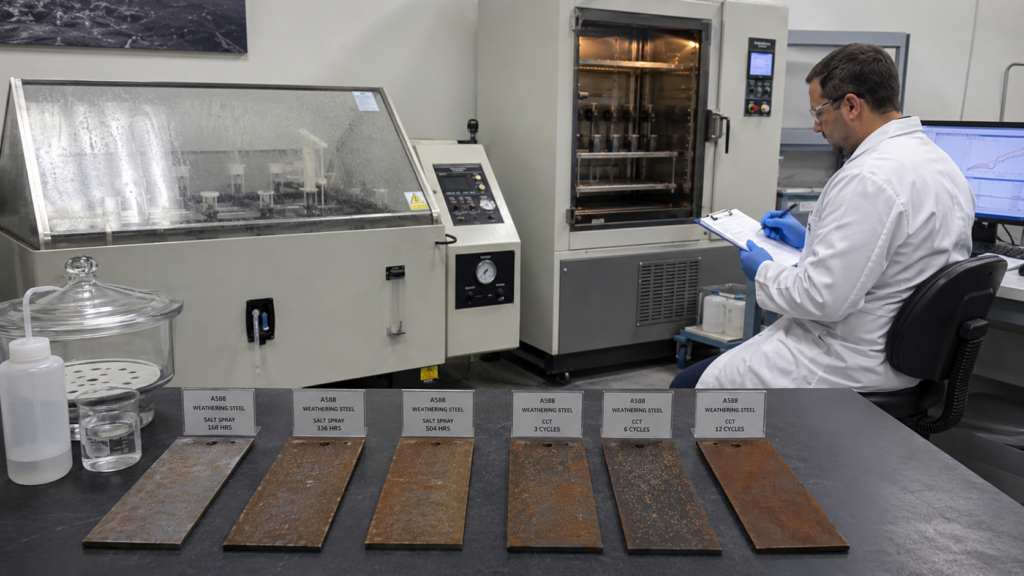
Salt Spray Testing
Salt spray testing is widely used for accelerated corrosion comparison. ASTM’s page for ASTM B117 describes the practice as covering the apparatus, procedure, and conditions required to create and maintain the salt spray test environment.
However, buyers should be careful. A588 steel salt spray test results can provide comparative corrosion information, but salt spray does not perfectly represent natural outdoor wet-dry exposure. It is useful, but it should not be treated as the only measure of long-term weathering performance.
Cyclic Corrosion Testing
Cyclic corrosion testing may be more relevant when the project needs wet-dry cycles, fog exposure, or changing environmental conditions.
Q-Lab’s education article on cyclic corrosion testing explains that cyclic corrosion testing is intended to be a more realistic way to perform salt spray testing than traditional steady-state exposure because actual atmospheric exposure includes wet and dry conditions.
For A588 Corrosion Testing, cyclic testing can help compare surface behavior under repeated wetting and drying.
Atmospheric Exposure and Surface Evaluation
Atmospheric exposure testing takes longer but can provide valuable project-specific insight. Surface evaluation also matters because scratches, mill scale condition, edge defects, weld zones, and water-trapping details may influence corrosion behavior.
For bridge projects, FHWA research on improved corrosion-resistant steel for highway bridge construction notes that ASTM A588 and other weathering steels do not develop a protective rust patina under high-salt exposure. That makes environmental assessment especially important for coastal or deicing-salt regions.
A588 Corrosion Testing vs Material Certificate
A material certificate is necessary, but it is not the same as A588 Corrosion Testing.
| Item | Material Certificate | A588 Corrosion Testing |
|---|---|---|
| Grade confirmation | Yes | Supports verification |
| Heat number | Yes | Used for sample traceability |
| Chemical composition | Yes | Can confirm independently |
| Mechanical properties | Yes | Not the main focus |
| Corrosion behavior | Usually no | Yes |
| Patina stability | No | Can be evaluated |
| Project environment suitability | Limited | More useful |
This difference matters for buyers who source A588 steel for outdoor structures. A certificate can show that the steel was supplied as ASTM A588, but A588 Corrosion Testing can provide additional evidence about corrosion behavior, surface condition, and project suitability.
When Should Buyers Request A588 Corrosion Testing?
Buyers should consider A588 Corrosion Testing when the steel will be exposed outdoors and long-term corrosion behavior matters.
Common situations include:
- bridge steel testing
- building facade projects
- exposed structural steel plates
- railway and transportation structures
- large export shipments
- new supplier qualification
- coastal or humid environments
- industrial atmospheric exposure
- owner-required third-party testing
- visible rust, surface defects, or inconsistent patina
- deciding whether A588 should be used bare or coated
A research article in PMC on weathering steel bridge corrosion influenced by deicing salts discusses how deicing salts used in winter road maintenance are a source of chlorides and can influence corrosion processes on weathering steel bridges. This is a strong reason to treat location and exposure conditions seriously.
A588 Steel for Bridges, Facades, and Outdoor Structures
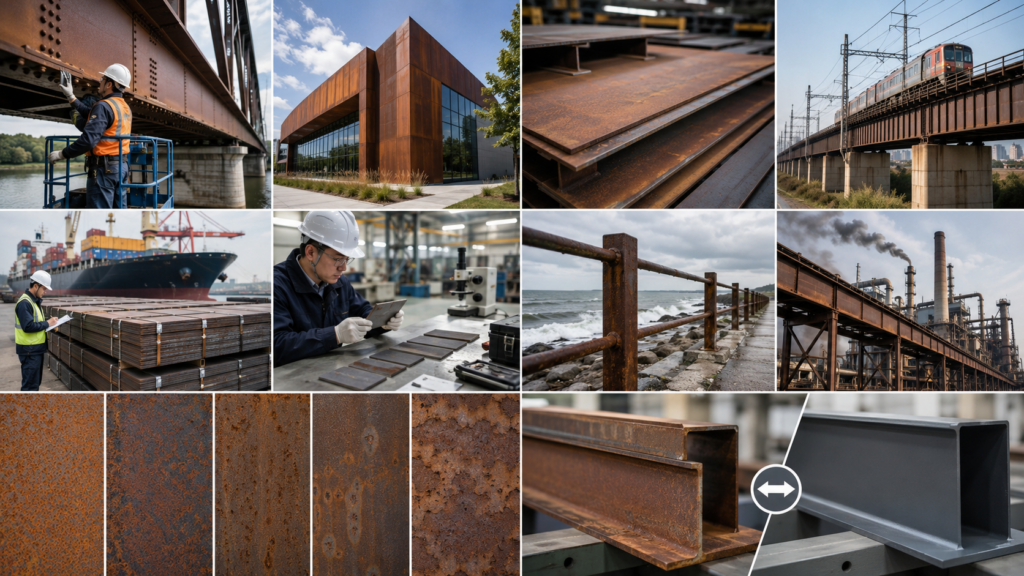
A588 is often used where both strength and atmospheric corrosion resistance are important. But different applications create different risks.
For bridges, the main concerns are drainage, chloride exposure, weld zones, inspection access, and long-term section loss.
For building facades, buyers may care about rust color, runoff staining, patina uniformity, and surface appearance.
For outdoor structural plates, the key issues may include water retention, edge corrosion, bolted connections, weld condition, and surface defects.
That is why A588 Corrosion Testing should be connected to the project environment, not selected only as a generic laboratory service.
What Should Be Included in an A588 Corrosion Testing Report?
A useful test report should be clear enough for buyers, engineers, and project owners to understand.
A professional A588 Corrosion Testing report may include:
- sample identification
- heat number
- steel grade
- test standard
- test method
- exposure condition
- exposure time
- corrosion observations
- mass loss or corrosion rating
- surface photos
- pitting observation
- chemical composition result
- conclusion and recommendation
- lab or inspector information
The goal is not only to produce data. The goal is to help the buyer make a decision.
How Steel Corrosion Testing Service Helps Reduce Project Risk
A steel corrosion testing service can support project risk control in several ways.
It can help buyers confirm whether the material matches the purchase requirement, whether the batch is consistent, whether surface quality is acceptable, and whether the steel is suitable for the intended environment.
For A588 steel material verification before shipment, A588 Corrosion Testing can also support inspection records, customer approval, supplier qualification, and engineering documentation.
In many outdoor projects, the cost of testing is small compared with the cost of premature corrosion, repainting, claim disputes, or rejected material.
Conclusion
A588 Corrosion Testing is important because ASTM A588 steel is not a no-rust material. It is a weathering steel that depends on proper chemistry, surface condition, drainage, and exposure environment to develop a stable protective patina.
For buyers sourcing A588 steel for bridges, facades, export shipments, or outdoor structural projects, A588 Corrosion Testing helps verify whether the material is suitable before long-term corrosion becomes a project problem.
FAQ
What is A588 Corrosion Testing?
A588 Corrosion Testing evaluates the corrosion resistance, surface behavior, and weathering performance of ASTM A588 steel for outdoor structural applications.
Does ASTM A588 steel rust?
Yes. ASTM A588 steel rusts because it is weathering steel, not stainless steel. Under suitable conditions, it forms a protective patina that slows further corrosion.
Is salt spray testing suitable for A588 steel?
Salt spray testing can provide accelerated corrosion comparison, but it does not fully represent natural outdoor weathering conditions.
Why is A588 corrosion testing needed if I already have a material certificate?
A material certificate confirms grade, chemistry, and mechanical properties. It may not show actual corrosion behavior, patina stability, surface condition, or project environment suitability.
What projects need A588 corrosion testing?
Bridge projects, outdoor structures, building facades, export shipments, coastal projects, and new supplier qualification may need A588 Corrosion Testing.
What should an A588 corrosion test report include?
It should include sample ID, heat number, test method, standard, exposure time, corrosion observations, photos, mass loss or rating, and a clear conclusion.
Is A588 corrosion testing only for bridges?
No. It is also useful for building facades, outdoor sculptures, railway structures, transmission towers, structural plates, and export shipments.