
In the global industrial supply chain, the reliability of a structure is only as strong as the data backing its materials. Mechanical testing steel is the foundational process that ensures a batch of metal meets the rigorous safety and performance requirements demanded by modern engineering. Whether it is for high-rise construction, automotive components, or aerospace fasteners, understanding how a material reacts under stress is non-negotiable.
For professionals in the field, these tests are not merely checkboxes on a Mill Test Certificate (MTC). They represent the physical boundaries of a material’s capability. This guide dives deep into the specific protocols, calculations, and standards—primarily ASTM E8—that govern the industry today.
Table of Contents
The Gold Standard: ASTM E8 and ISO 6892-1
When we discuss the tension testing of metallic materials, two standards dominate the landscape. The first is ASTM E8/E8M standard test methods, which is the primary reference in the United States and much of the international trade market. Its counterpart, ISO 6892-1 metallic materials tensile testing, provides a similar framework used extensively in Europe and Asia.
Adhering to these standards ensures that mechanical testing steel results are reproducible across different laboratories. Without a standardized approach, variations in cross-head speed or specimen temperature could lead to catastrophic misinterpretations of a material’s true strength.
Specimen Preparation: The “Dog-Bone” Geometry
The accuracy of a test begins long before the machine is turned on. The preparation of the test piece is critical. In most industrial settings, technicians use dog-bone tensile specimen dimensions to ensure that the fracture occurs within the “gauge length” rather than near the machine grips.
If the specimen is not machined correctly, the results will suffer from grip effects on tensile test accuracy. Stress concentrations near the shoulders can lead to premature failure, giving a false reading for the material’s ductility. Proper machining according to ASTM E8 ensures that the stress is distributed uniformly across the reduced section.
The Yield Strength Calculation: The 0.2% Offset Method
For many structural engineers, the yield point is the most critical data point. It marks the transition from elastic deformation (where the metal returns to its original shape) to plastic deformation (permanent stretching). However, for many steel alloys, the transition is subtle and does not show a clear “drop” in the stress-strain curve.
This is where the offset method for yield strength 0.2% becomes essential. In this procedure, a line is drawn parallel to the elastic portion of the curve, starting at 0.2% strain on the x-axis. The point where this line intersects the stress-strain curve is defined as the yield strength.
The fundamental yield strength calculation follows the formula:
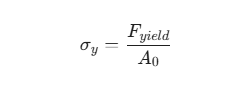
Rigorous mechanical testing steel protocols require that this area is measured with calibrated micrometers before the test begins to ensure the highest precision.
Ultimate Tensile Strength (UTS) and Necking
As the test continues beyond the yield point, the material undergoes strain hardening. It becomes harder to stretch until it reaches its peak resistance. This peak is known as the Ultimate Tensile Strength (UTS) vs Yield Point comparison. While the yield strength tells you when the material will start to deform, the UTS tells you the maximum load the cross-section can handle before “necking” begins.
During necking, the specimen begins to thin rapidly at a single point, leading to eventual fracture. For a quality manager, mechanical testing steel must provide both values to determine the safety factor of a design.
Ductility and Steel Elongation Properties
Strength is only half the story; ductility is the other. Steel elongation properties describe the ability of a metal to deform plastically without breaking. This is measured by joining the fractured ends of the specimen and measuring the increase in the gauge length.
The gauge length for steel elongation measurement is standardized to ensure the data is comparable. In addition to elongation, laboratories often measure the reduction of area in tensile test, which is another vital indicator of a material’s toughness. A high reduction in area typically signifies a ductile material that can absorb energy before failure.
Mechanical Properties Comparison Table
The following table displays the typical ranges for common industrial grades as verified through standard mechanical testing steel procedures.
| Steel Grade | Yield Strength (MPa) | UTS (MPa) | Elongation (%) | Hardness (HB) | Common Standards |
| ASTM A36 | $\ge 250$ | 400 – 550 | $\ge 20$ | 119 – 159 | Structural Steel |
| AISI 1045 | $\ge 310$ | $\ge 570$ | $\ge 12$ | 163 – 229 | Machinery Parts |
| AISI 4140 | $\ge 415$ | $\ge 655$ | $\ge 18$ | 197 – 241 | High-Strength Alloy |
Note: Values depend on heat treatment state (e.g., Annealed, Q&T).
The Stress-Strain Curve: A Roadmap of Performance
Every session of mechanical testing steel produces a unique stress-strain curve. Interpreting this curve is an art as much as a science.
1.Elastic Region: The initial linear portion where Young’s modulus of steel calculation takes place.
2.Yielding: The point of permanent deformation.
3.Strain Hardening: Where the material reorganizes its crystalline structure to resist further load.
4.Necking and Fracture: The final stages before complete failure.
Understanding the stress-strain curve phases for carbon steel allows engineers to predict how a component will fail under extreme overload, which is essential for forensic engineering and failure analysis.
Advanced Testing and Compliance
In modern high-stakes industries, simply having a machine is not enough. Tensile testing machine calibration requirements must be met annually to ensure that the load cells and extensometers are accurate. Furthermore, the effect of strain rate on tensile test results can be significant; pulling a sample too fast can artificially inflate the yield strength readings.
For B2B buyers, interpreting mill test certificates (MTC) results is the final step in the procurement chain. If the MTC shows a discrepancy, a third-party laboratory for steel mechanical analysis should be employed to conduct an independent audit. This ensures mechanical testing for structural steel compliance is met before any material is used in a bridge or skyscraper.
Conclusion: The Critical Nature of Precision
Ultimately, mechanical testing steel is about risk management. It is the process that turns a piece of raw iron into a certified engineering material. By strictly following ASTM E8/E8M standard test methods and focusing on precise yield strength calculation and steel elongation properties, manufacturers can guarantee the safety of their products.
As technology advances, we see more digital integration in the lab, but the core physics remains the same. Whether you are measuring the dog-bone tensile specimen dimensions or calculating the Young’s modulus, precision is the only path to a reliable result. Mechanical testing steel remains the silent guardian of our modern infrastructure.
FAQ
What is the most common error in tensile testing?
Improper specimen preparation. If the dog-bone tensile specimen dimensions are off, or if there are surface scratches, the sample will fail prematurely.
Why is 0.2% used for the yield offset?
It is an arbitrary industry standard that provides a consistent way to define the “start” of plastic deformation in materials that don’t have a distinct yield point.
Does temperature affect mechanical testing steel results?
Absolutely. Most standards require testing at room temperature (10°C to 35°C). Extreme heat or cold will significantly alter both strength and ductility.
How do I know if my lab is compliant?
Check for ISO 17025 accreditation and ensure they follow ASTM E8 tensile test or ISO 6892-1 protocols with up-to-date calibration certificates.