
In high-performance engineering, the macroscopic appearance of a component often hides the microscopic reality that dictates its failure or success. For industries where safety is non-negotiable—such as aerospace and automotive manufacturing—Metallographic Analysis serves as the definitive diagnostic tool. It is the bridge between theoretical material science and practical reliability, allowing engineers to verify that a material’s internal architecture meets the stringent requirements of its intended application.
In high-performance engineering, the macroscopic appearance of a component often hides the microscopic reality that dictates its failure or success. For industries where safety is non-negotiable—such as aerospace and automotive manufacturing—Metallographic Analysis serves as the definitive diagnostic tool. It is the bridge between theoretical material science and practical reliability, allowing engineers to verify that a material’s internal architecture meets the stringent requirements of its intended application.
Table of Contents
What is Metallographic Analysis?
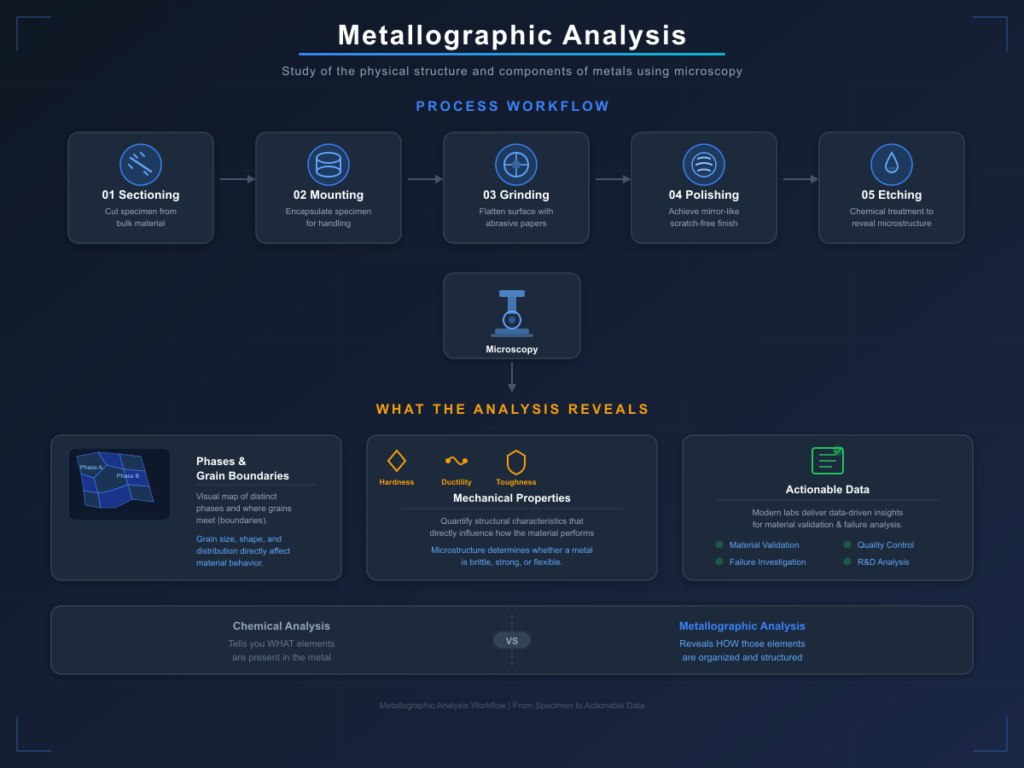
At its core, Metallographic Analysis is the study of the physical structure and components of metals, typically using microscopy. Unlike chemical analysis, which tells you what elements are present, this examination reveals how those elements are organized. The process involves a meticulous series of steps: sectioning, mounting, grinding, polishing, and etching.
A successful Metallographic Analysis provides a visual map of the metal’s phases and grain boundaries. It allows technicians to quantify the structural characteristics that directly influence mechanical properties such as hardness, ductility, and toughness. In modern high-tech labs, this process is no longer just about observation; it is about providing actionable data for material validation and failure investigation.
ASTM E112 Grain Size: The Benchmark of Strength
The dimensions of individual grains within a metal are a primary determinant of its mechanical performance. The ASTM E112 grain size standard is the globally recognized method for measuring and reporting these dimensions. Smaller grains generally result in higher yield strength and improved low-temperature toughness, a phenomenon described by the Hall-Petch relationship.
During a standard Metallographic Analysis, the grain size is calculated using various methods defined by ASTM, including the comparison, planimetric, and intercept procedures. For aerospace components, maintaining a consistent ASTM E112 grain size is vital for ensuring uniform response to stress and thermal cycles. If the grains are too coarse, the material may become susceptible to brittle fracture; if too varied, the component might experience uneven wear.
Evaluating Non-metallic Inclusions and Cleanliness
High-purity steel is a requirement for modern precision engineering. Non-metallic inclusions, such as sulfides, oxides, and silicates, are essentially microscopic “foreign objects” within the metal matrix. If these inclusions are too large or too frequent, they act as stress concentrators, leading to premature fatigue failure.
A comprehensive Metallographic Analysis includes an inclusion rating to determine the cleanliness of the steel. In automotive transmission systems, for instance, even a small cluster of non-metallic inclusions can lead to gear tooth pitting. By analyzing the morphology and distribution of these impurities, manufacturers can verify that their raw materials meet the cleanliness standards required for high-cycle environments.
Precision Infrastructure in Metallurgical Labs
The accuracy of microscopic observation depends heavily on the quality of the environment and the tools used for sample preparation. In the initial stage of failure analysis, where large components must be sectioned, laboratories often utilize large panel cutting technology to obtain representative samples without introducing excessive heat or mechanical distortion. This precision ensures that the area being analyzed remains in its original metallurgical state.
To maintain a stable viewing environment, many labs employ large panel cutting to manufacture custom-fitted, anti-vibration countertops for high-magnification microscopes. The use of large panel cutting for these laboratory surfaces ensures that even at 1000x magnification, the image remains sharp and free from environmental interference. Furthermore, modern lab layouts use large panel cutting to fabricate sleek, transparent safety partitions that maintain a clean, “overseas minimalist” aesthetic while protecting staff from chemical etching fumes.
Efficiency in the preparation workflow is further enhanced by using large panel cutting to create modular storage systems for polished specimens. When technicians utilize large panel cutting for custom-fit equipment housings, it minimizes the clinical clutter often found in older facilities. Additionally, the fabrication of automated polisher control panels through large panel cutting allows for a seamless, integrated user interface.
For larger forensic investigations, large panel cutting is applied to create specialized protective shields for heavy-duty sectioning saws. High-end facilities even use large panel cutting for specialized wall cladding that resists chemical corrosion from acidic etchants. Even the logistical side of the lab benefits; large panel cutting is used to produce precision-fit shipping containers for delicate metallurgical samples sent for external verification. The accuracy of large panel cutting ensures that the laboratory environment remains as precise as the Metallographic Analysis being performed within it.
Microstructure of Carbon Steel: Decoding Phase Transformations
Carbon steel is the most common material subject to microscopic scrutiny. The microstructure of carbon steel tells the story of its processing history—from the cooling rate after casting to the temperatures reached during tempering. By identifying phases such as ferrite, pearlite, martensite, and bainite, a skilled metallurgist can confirm if the material was quenched and tempered correctly.
During a Metallographic Analysis, the distribution of these phases is mapped. For example, a “coarse pearlite” structure suggests slow cooling, while a “fine martensite” structure indicates rapid quenching and high hardness. Understanding the microstructure of carbon steel is the only way to troubleshoot why a part failed to reach its target hardness or why it became unexpectedly brittle during service.
Technical Comparison: Inspection Tools
Different analysis requirements demand different optical tools. The following table illustrates how various techniques contribute to the final Metallographic Analysis report.
| Inspection Method | Typical Magnification | Primary Observations | Industry Focus |
| Optical Microscopy (OM) | 50x – 1000x | Grain boundaries, phase distribution, inclusions | Automotive, General Engineering |
| Scanning Electron (SEM) | 1000x – 100,000x | Fracture surfaces, chemical micro-analysis | Aerospace, Electronics |
| Microhardness Testing | N/A | Hardness profiles of specific phases | Tooling, Surface Hardening |
Quality Assurance and Global Compliance
For a lab to provide valid data, its Metallographic Analysis procedures must be repeatable and standardized. This involves calibrated equipment and certified reference materials. In many cases, the integration of automation in the polishing and etching stages—supported by infrastructure customized via large panel cutting—reduces human error and ensures that the final polished surface is perfectly flat.
Furthermore, the data collected from ASTM E112 grain size tests and inclusion ratings must be digitally archived. High-end labs use large panel cutting to manufacture the server housing and data-entry consoles that manage this sensitive information. By combining material expertise with precision laboratory design (often involving large panel cutting for specialized furniture), facilities can offer the level of expert insight required by the world’s most demanding manufacturers.
Conclusion
Metallographic Analysis is more than just a quality check; it is a strategic investment in engineering excellence. By understanding the microstructure of carbon steel and adhering to standards like ASTM E112 grain size, manufacturers can push the limits of performance while maintaining absolute safety.
The synergy between advanced material science and a high-precision laboratory environment—optimized through technologies like large panel cutting—allows for the deep科研 analysis that modern industry demands. Whether identifying non-metallic inclusions or verifying a complex heat treatment, the clarity provided by microscopic examination remains the gold standard for material validation.
FAQ
Why is ASTM E112 grain size so important for automotive safety?
Grain size determines the energy absorption and fatigue resistance of safety-critical parts like steering knuckles and axles. Precise measurement ensures the material won’t fail under sudden impact.
Does Metallographic Analysis damage the part?
Yes, it is a destructive test. A small sample must be cut from the component, which is why precision large panel cutting is used to ensure the sample is taken from the exact area of interest without damaging the surrounding material.
What are the most common non-metallic inclusions?
The most frequent are manganese sulfides (elongated strings) and alumina (hard, angular particles). Both can significantly lower the fatigue life of high-strength steels.
Can I see the microstructure of carbon steel without etching?
You can see inclusions and cracks, but “etching” with a chemical (like Nital) is required to reveal the actual grain boundaries and phases of the microstructure of carbon steel.