
Structural integrity in heavy-duty engineering relies on more than just yield strength. While S355 steel is defined by its 355 MPa minimum yield point, its actual performance under stress is determined by its resistance to brittle fracture. For engineers and procurement managers working in high-latitude regions or with dynamic loads, the S355 Charpy Impact Test is the mandatory protocol for verifying material toughness.
Table of Contents
Understanding Toughness Grades in EN 10025-2
The European standard EN 10025-2 categorizes S355 steel into several grades based on energy absorption levels at specific temperatures. These suffixes—JR, J0, and J2—are not merely labels; they represent specific data points derived from an S355 Charpy Impact Test.
The “J” stands for Joules (the energy absorbed), while the following character indicates the testing temperature. For instance, the S355JR impact test is conducted at room temperature (+20°C). If the environment involves freezing conditions, an upgrade to S355J0 (0°C) or S355J2 (-20°C) is required to ensure low temperature steel safety.
Mechanics of the S355 Charpy Impact Test Protocol
The standard execution of the S355 Charpy Impact Test follows ISO 148-1 protocols. A specimen, typically measuring 10x10x55mm, is machined with a specific V-shaped notch. This notch acts as a stress concentrator, simulating real-world surface defects or welds where cracks might initiate.
During the S355 Charpy Impact Test, a weighted pendulum strikes the specimen opposite the notch. The energy absorbed by the steel during fracture is measured in Joules. This value is critical for determining whether the material will undergo ductile deformation or catastrophic brittle failure. For a batch to pass, the Charpy V-notch values must meet a minimum average of 27 Joules at the specified grade temperature.
Analyzing Charpy V-notch Values for Engineering Compliance
The resulting Charpy V-notch values provide more than just a “pass/fail” metric. Metallurgists analyze the fracture surface of the specimen to determine its crystallinity. A fibrous fracture indicates high ductility, while a grainy, shiny surface suggests brittleness.
When evaluating S355J2 vs S355JR toughness, the distinction is stark. An S355JR grade might provide 27J at room temperature but drop to 5J or less at -20°C, leading to immediate structural collapse under load. This is why the S355 Charpy Impact Test is performed at precisely controlled temperatures using ethanol or liquid nitrogen cooling baths to simulate extreme operational environments.
S355J2 vs S355JR Toughness in Heavy Machinery Applications
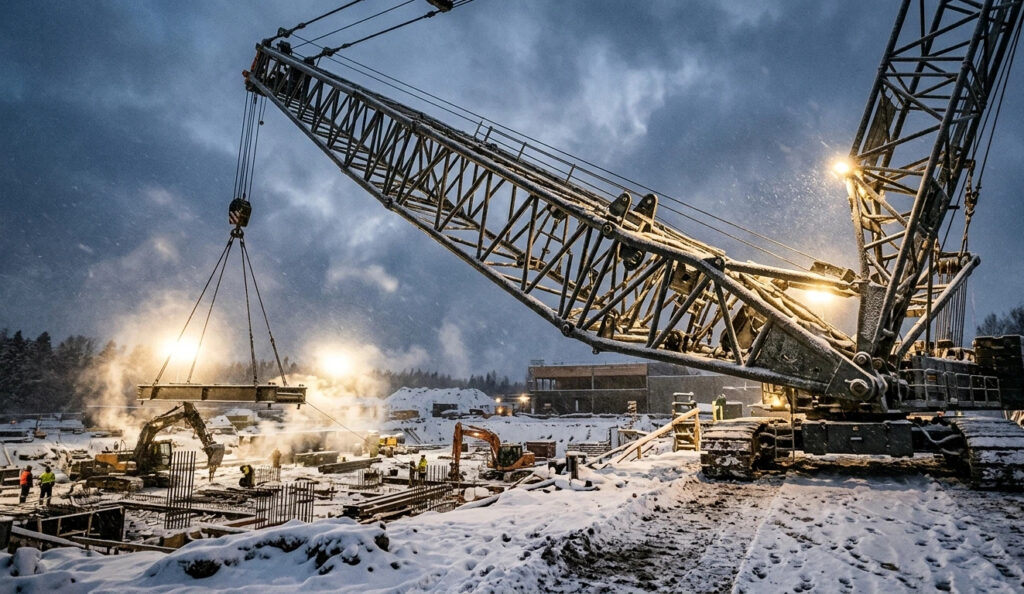
For the construction of cranes, excavators, and offshore platforms, the debate between S355J2 vs S355JR toughness is a matter of liability and safety. Steel testing for heavy machinery must account for the fact that dynamic impacts—such as a crane lifting a sudden load—require the material to absorb energy rapidly.
If the steel has not undergone a rigorous S355 Charpy Impact Test, there is no verification that it can handle these peak stress events. This is particularly true for welded joints, where the heat-affected zone (HAZ) can often become more brittle than the base metal, necessitating further testing of the weldment itself.
Mandatory Verification of S355 Impact Energy at -20°C
In procurement, simply trusting the grade stamp is insufficient. Professional buyers must verify the S355 impact energy at -20°C by examining the Mill Test Certificate (MTC). An authentic MTC will list the results of the S355 Charpy Impact Test for each heat number.
According to authoritative technical documentation from the European Committee for Standardization (CEN), the S355J2 grade must maintain structural stability at sub-zero temperatures. You can reference the full technical specifications for EN 10025-2 via the BSI Group or the ISO 148-1 Standards page.
Critical Strategies for Low Temperature Steel Safety
To optimize low temperature steel safety, engineers should specify normalized or thermo-mechanically rolled (S355J2+N or S355J2+M) variations. These processes refine the grain structure, which directly improves the outcomes of the S355 Charpy Impact Test.
Fine-grained steel provides more boundaries to stop crack propagation, ensuring that even if a crack starts, the material remains ductile enough to prevent a full break. Failure to verify these properties through an S355 Charpy Impact Test can lead to brittle fracture, which occurs at the speed of sound and gives no warning before failure.
Standardized Steel Testing for Heavy Machinery
When sourcing, the S355 Charpy Impact Test should be conducted by ISO 17025 accredited laboratories. This ensures that the pendulum’s friction, the specimen’s temperature at the moment of impact, and the notch geometry are all within strict tolerances.
In the context of steel testing for heavy machinery, third-party inspection (TPI) is often utilized to witness the S355 Charpy Impact Test. This level of scrutiny ensures that the Charpy V-notch values reported are accurate and that the steel will perform as expected in the field.
The Engineering Necessity of the S355 Charpy Impact Test
Ultimately, the S355 Charpy Impact Test is the bridge between theoretical design and real-world reliability. Whether comparing S355J2 vs S355JR toughness or calculating the required S355 impact energy at -20°C, the data derived from the impact test is the final word on safety.
By prioritizing comprehensive steel testing for heavy machinery, manufacturers can eliminate the risk of brittle fracture. This commitment to low temperature steel safety protects not only the equipment but also the personnel operating in harsh environments. Ensuring every batch passes its S355 Charpy Impact Test is the only way to guarantee that “S355” means more than just a number—it means structural confidence.
In the demanding world of heavy-duty engineering, the difference between peak performance and catastrophic failure lies in the precision of a single test. Ensure your project’s resilience with our certified S355 solutions—where every batch is verified by rigorous Charpy Impact Testing for total structural confidence.
FAQ
What is the minimum value for an S355JR impact test?
The minimum requirement is an average of 27 Joules at +20°C.
Why are Charpy V-notch values important for cranes?
They ensure the steel can absorb sudden shocks without snapping, which is vital for lifting safety in cold weather.
Can S355J2 be used instead of S355JR?
Yes. S355J2 has superior toughness and is tested at -20°C, making it a safer, higher-performing alternative to JR.
How does temperature affect S355 impact energy at -20°C?
As temperature drops, steel becomes more brittle. The J2 grade is specifically manufactured to remain ductile at these lower temperatures.
Where can I find the official S355 testing standards?
The primary standards are EN 10025-2 for material specs and ISO 148-1 for the test method.