
In the high-stakes world of offshore oil and gas, chemical processing, and medical device manufacturing, material failure is not just an inconvenience—it is a potential catastrophe. While SS316L is celebrated for its corrosion resistance, the global supply chain often introduces variability that can compromise engineering safety. Relying solely on a Mill Test Report (MTR) is a gamble that many modern firms are no longer willing to take. This has led to a surge in specialized SS316L Testing as the ultimate safeguard for material integrity.
The “L” in 316L stands for “Low Carbon,” a critical distinction that determines how the metal behaves during welding and long-term exposure to harsh environments. Without rigorous SS316L Testing, engineers risk using material that may look identical to standard 316 but lacks the vital micro-structural stability required for mission-critical applications. This guide breaks down the essential testing protocols that bridge the gap between “paper compliance” and “real-world performance.”
Table of Contents
PMI Material Verification: The First Line of Defense
Positive Material Identification, or PMI material verification, is the non-destructive starting point for any inspection sequence. In a globalized market, material mix-ups are more common than most procurement managers care to admit. SS316L Testing begins here to ensure the core alloying elements—specifically Molybdenum (Mo), Chromium (Cr), and Nickel (Ni)—fall within the tight tolerances defined by the AISI standards.
For 316L, the Molybdenum content must remain between 2.0% and 3.0%. This element is the primary reason 316L outperforms 304 in chloride-rich environments. Handheld X-ray Fluorescence (XRF) or Optical Emission Spectroscopy (OES) provides instant verification. However, OES is often preferred in comprehensive SS316L Testing because it can accurately detect Carbon levels, which is the only way to distinguish 316 from 316L on-site.
Validating the ‘L’: ASTM A262 and Intergranular Corrosion Sensitivity
The most dangerous vulnerability in stainless steel is “sensitization.” During welding, if the carbon content is too high, chromium carbides form at the grain boundaries, leaving the adjacent areas depleted of chromium. This leads to rapid corrosion along the grain boundaries. SS316L Testing must address this through ASTM A262 Intergranular Corrosion testing.
The intergranular corrosion test procedure usually involves “Practice E” (The Strauss Test) or “Practice A” (Oxalic Acid Etch). According to the ASTM International A262 standard, Practice E involves immersing a specimen in a boiling copper-copper sulfate-sulfuric acid solution for 15 to 24 hours, followed by a 180-degree bend test. If the material “crazes” or cracks, it indicates sensitization. For any project requiring SS316L marine grade certification, passing this test is non-negotiable to ensure the heat-affected zones (HAZ) of welds won’t fail prematurely.
PREN Calculation: Quantifying Pitting Resistance
In marine engineering, the ability to resist “pitting”—small, localized holes that can breach a pipe wall—is measured by the Pitting Resistance Equivalent Number (PREN). A key part of professional SS316L Testing is the verification of the chemical weights to feed into the PREN calculation formula.
The formula used by metallurgists is:
For SS316L to be effective in seawater, it typically requires a PREN value > 24. If your SS316LTestingresults indicate a Chromium or Molybdenum content at the lower end of the allowedspectrum, your PREN might drop to 22.5, which is a significant risk factor in tropical marineenvironments or high-temperature chemical plants.
ISO 9227 Salt Spray Test: Simulating Harsh Reality
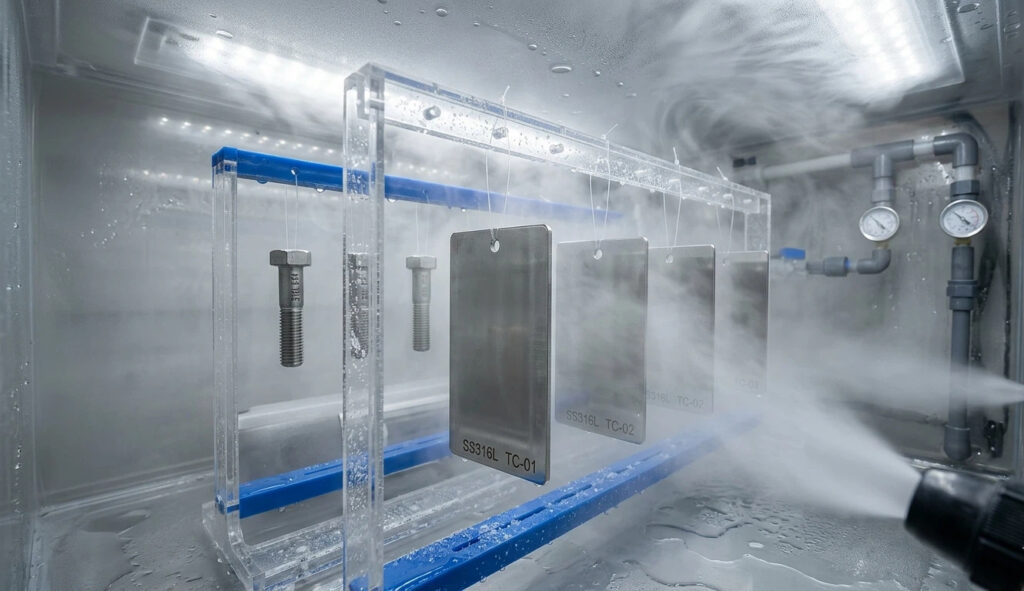
While chemical analysis predicts performance, environmental testing proves it. The ISO 9227 Salt Spray Test (often referred to as NSS or Neutral Salt Spray) places components in a chamber where they are subjected to a continuous fog of 5% NaCl solution at 35°C.
Industry-Specific Testing Demands
The intensity of SS316L Testing varies significantly depending on the end-use environment.
- Marine Engineering: Focuses heavily on the ISO 9227 Salt Spray Test and PREN values to combat chloride-induced stress corrosion cracking (CSCC).
- Chemical Processing: Prioritizes ASTM A262 Intergranular Corrosion checks, especially for vessels handling nitric or acetic acids where grain boundary integrity is vital.
- Medical Equipment: Requires SS316L Testing that includes surface finish analysis and biocompatibility checks. Any trace of surface iron can lead to infection or device rejection.
In all these sectors, the “L” variant is chosen specifically for its weldability. Therefore, testing the weld coupons is often more important than testing the base metal itself.
The ROI of Third-Party SS316L Testing
Investing in independent SS316L Testing is an insurance policy. The cost of a PMI check or a corrosion bench test is negligible compared to the $100,000+ per day cost of an unplanned shutdown in a refinery or the legal liability of a failed medical implant.
By insisting on comprehensive SS316L Testing, companies transition from a reactive “fix it when it breaks” mindset to a proactive quality assurance model. This ensures that the material used in your project is exactly what was ordered, processed correctly, and capable of surviving the decades of service it was designed for.
Optimize Your Project Integrity
Don’t leave your material performance to chance.
we provide end-to-end SS316L Testing solutions tailored for the marine and chemical sectors. Whether you need a simple PMI material verification or a complex intergranular corrosion test procedure to satisfy regulatory bodies, our certified laboratory delivers the data you need to build with confidence.
[Click Here to Request a Technical Consultation for Your 316L Project] and ensure your infrastructure stands the test of time.
FAQ
What is the main difference between 316 and 316L in testing?
Testing 316L specifically focuses on the carbon content (must be under 0.03%) and its resistance to sensitization during the ASTM A262 Testing process, which standard 316 often fails after welding.
How do I know if my 316L is ‘Marine Grade’?
Look for a SS316L Testing report that confirms a PREN value of at least 24 and successful completion of a 1,000-hour ISO 9227 Salt Spray Test.
Can PMI detect if the steel is ‘L’ grade?
Standard XRF PMI cannot detect carbon. To verify the “L” (Low Carbon) status on-site, you need a Spark OES (Optical Emission Spectroscopy) unit as part of your SS316L Testing equipment.