
For engineers in the automotive and heavy machinery sectors, the reliability of a high-stress component—be it a transmission gear, a structural bolt, or a drive shaft—hinges on a single metallurgical metric: hardness. While AISI 4140 is a versatile chromium-molybdenum alloy, its performance is entirely dependent on its response to thermal processing.
A standard AISI 4140 Hardness Test is not just a quality control formality; it is a diagnostic tool that reveals the internal integrity of the steel. Inconsistent hardening can lead to catastrophic fatigue failure in gears or brittle fracture in automotive bolts. To avoid these risks, laboratories must look beyond the surface Rockwell C (HRC) value and analyze the depth of the martensitic transformation.
Table of Contents
Understanding Jominy Hardenability in 4140 Steel
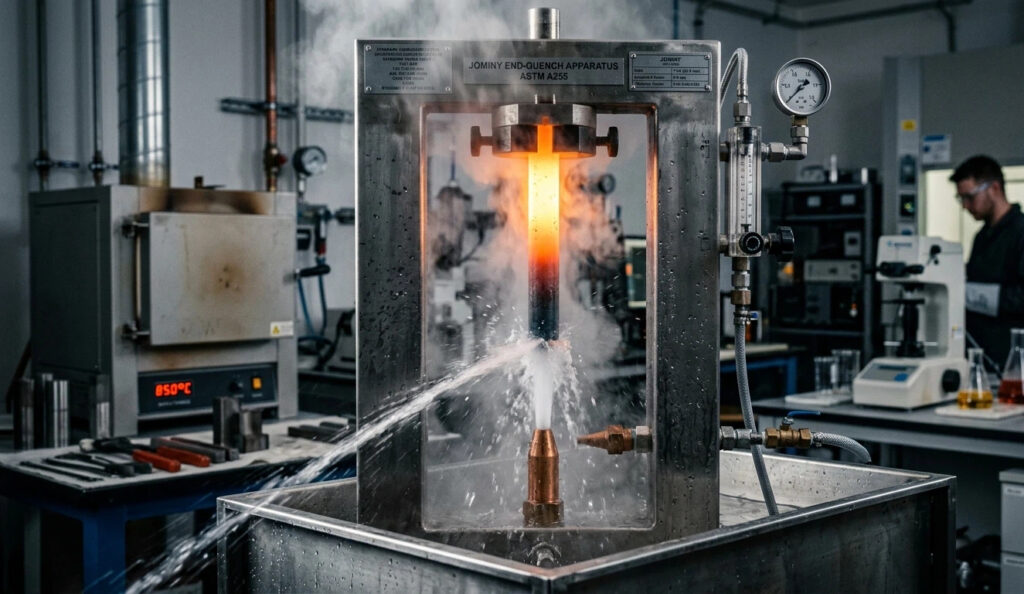
Hardenability is the inherent ability of a steel to transform into martensite—the hard, needle-like structure—during quenching. For AISI 4140, this is typically measured using the Jominy End-Quench Test, governed by ASTM A255.
In this procedure, a standardized 1-inch diameter bar is heated to the austenitic temperature and then quenched at one end with a controlled water jet. By performing an AISI 4140 Hardness Test at specific intervals along the length of the bar, technicians can map how the hardness drops as the cooling rate slows down.
For automotive gear manufacturers, the Jominy curve is a predictive map. It tells the engineer exactly how deep the hardness will penetrate in a 50mm gear compared to a 10mm bolt. If the manganese or chromium levels are at the lower end of the allowed chemical range, the hardenability will suffer, leading to soft cores in larger sections.
Precision Protocols for an AISI 4140 Hardness Test
Accuracy in testing begins with surface preparation. Any AISI 4140 Hardness Test performed on an oxidized or decarburized surface will yield false negatives. During the heat treatment of 4140 bolts, carbon can migrate out of the surface layer (decarburization), leaving a soft “skin” of ferrite.
To prevent this, the laboratory protocol must include:
1.Sectioning and Grinding: Removing at least 0.5mm of the surface to reach the true bulk material.
2.Tester Selection: While the Rockwell C scale is standard for tempered parts, the Brinell (HBW) scale is often superior for raw forged 4140 billets due to its larger indentation area, which averages out local grain variations.
3.Verification: Using certified test blocks that are within $\pm 1.0\text{ HRC}$ of the expected value.
Executing an AISI 4140 Hardness Test without verifying the absence of surface decarburization is a leading cause of field failures in automotive fasteners. If the surface is too soft, the threads will strip; if the core is too hard, the bolt will snap under vibration.
The Role of the 4140 Steel Hardness vs Tempering Temperature Chart
The most critical phase for 4140 reliability is tempering. After quenching, 4140 is extremely hard but too brittle for most engineering applications. Technicians use a 4140 steel hardness vs tempering temperature chart to “dial in” the perfect balance of strength and toughness.
As the tempering temperature rises from 200° C to 650° C, the hardness drops predictablywhile the impact energy (toughness) increases. For high-strength automotive bolts, temperingis usually performed at the lower end (400° C-450° C) to maintain high yield strength. Forgears requiring fatigue resistance, a higher temper is chosen to ensure the core can absorbcyclic loads.
Laboratories must validate that the heat treater has followed the chart accurately. A 20° Cdeviation in the furnace can result in a 3-5 HRC difference, which significantly alters thefatigue life of the part.
Managing Surface vs Core Hardness in Large Diameter 4140 Shafts
In large-scale automotive components, “center-to-surface” uniformity is the ultimate challenge. Dealing with Surface vs Core hardness in large diameter 4140 shafts requires a deep understanding of the alloy’s quenching speed.
Because 4140 is a “through-hardening” steel, it is designed to achieve a consistent structure throughout its volume. However, in shafts exceeding 100mm in diameter, the center cools much slower than the exterior. This creates a hardness gradient. An AISI 4140 Hardness Test performed only on the surface will not reveal a soft, pearlitic core that might fail under torsional stress.
To address this, advanced testing services utilize cross-sectional hardness mapping. Bycutting a “wafer” from the shaft and performing a series of Vickers or Rockwell tests from theedge to the center, engineers can calculate the “effective hardness depth.” If the corehardness is more than 10% lower than the surface, the quenching medium (oil vs. polymer)may need adjustment.
How the AISI 4140 Hardness Test Dictates Gear Reliability
In automotive gear manufacturing, the interaction between core toughness and surface wear resistance is vital. Many gears undergo induction hardening, where only the teeth are heated and quenched. In this scenario, the AISI 4140 Hardness Test must be performed on two distinct zones.
1.The Case: The tooth face must reach 50-55 HRC to resist pitting.
2.The Core: The root of the tooth must remain at 30-35 HRC to provide the ductilityneeded to prevent “tooth snapping” under peak torque.
Modern QC labs are increasingly moving toward Non-destructive hardness testing forautomotive gears. Techniques like Ultrasonic Contact Impedance (UCI) allow for high-speedtesting of every single gear on a production line without leaving the large indentation markstypical of traditional Brinell testers. This ensures 100% compliance without sacrificing thepart’s surface finish.
Establishing the Correlation Between HRC and Tensile Strength for 4140
One of the most valuable aspects of the AISI 4140 Hardness Test is its ability to act as a proxy for tensile testing. For many components, performing a full destructive tensile test is too expensive or impossible due to the part’s geometry.
There is a direct Correlation between HRC and Tensile Strength for 4140. Usingstandardized conversion tables (such as ASTM E140), a hardness of 30 HRC roughlytranslates to a tensile strength of 950 MPa (138, 000 psi).
The general formula used by engineers for an estimate is:
By utilizing this correlation, a simple AISI 4140 Hardness Test can provide an immediate safety assessment of a batch of structural bolts. If the HRC value is too low, the engineer knows the tensile strength has dropped below the design safety factor, and the parts must be quarantined.
Conclusion
The AISI 4140 Hardness Test is far more than a “pass/fail” check. It is the bridge between chemical composition and mechanical reality. By integrating the 4140 steel hardness vs tempering temperature chart into the testing workflow and accounting for the differences in Surface vs Core hardness in large diameter 4140 shafts, manufacturers can guarantee the longevity of their products.
In an industry where a single failed gear can lead to a massive vehicle recall, the precision of your hardness data is your strongest defense. Whether using traditional destructive methods or the latest Non-destructive hardness testing for automotive gears, the goal remains the same: ensuring that every piece of 4140 steel performs exactly as the engineers intended.
By leveraging the Correlation between HRC and Tensile Strength for 4140, quality managers can make data-driven decisions that balance production speed with uncompromising safety standards. Don’t just test for a number—test for the integrity of your brand.
Don’t leave your component’s integrity to guesswork. Partner with our ISO-certified laboratory for precision AISI 4140 Hardness Testing and ensure your automotive parts exceed every industry safety standard. [Contact our metallurgical experts today for a custom testing protocol.]
FAQ
Why does my 4140 bolt show a low HRC value despite correct heat treatment?
This is often due to surface decarburization. Ensure you have ground down at least 0.3-0.5mm from the surface before conducting the AISI 4140 Hardness Test.
What is the maximum hardness 4140 can achieve?
A: Immediately after quenching, 4140 can reach 54-59 HRC. However, it is never used in this state due to extreme brittleness.
Can I use Rockwell B for AISI 4140?
Only in the fully annealed state. Once 4140 is tempered for automotive applications, the Rockwell C (HRC) or Brinell (HBW) scales are required to accurately capture the material’s strength.
Is the Jominy test necessary for every batch?
While not necessary for every small order, it is a mechanical necessity for high-volume automotive contracts to verify the hardenability consistency between different steel melts.