
A106 B Pipe Inspection should not start after the pipe arrives at the project site. For ASTM A106 Grade B pipes used in pressure piping, boiler manufacturing, and oil and gas service, the real risk is often hidden in paperwork mismatch, missing test records, thin-wall areas, poor traceability, or surface damage before shipment.
Table of Contents
Why Should A106 B Pipe Inspection Start Before Shipment?
ASTM describes A106 / A106M seamless carbon steel pipe as pipe for high-temperature service, suitable for welding, bending, flanging, and similar forming operations. That is why ASTM A106 Grade B is common in pressure pipe, boiler, refinery, and oil and gas projects.
But grade name alone does not prove the pipe is ready for service.
Before shipment, inspectors should check:
- standard and grade;
- pipe size and schedule;
- heat number;
- MTC data;
- pipe marking;
- visual condition;
- outside diameter and wall thickness;
- hydro test or NDT record;
- packing and quantity.
For a steel pipe inspection service, the job is not only to “look at the pipe.” The job is to connect the document, pipe body, test record, and shipment condition into one traceable chain.
Can the MTC Match the Pipe Marking?
MTC verification is the first gate in ASTM A106 Grade B inspection.
A material test certificate should match the actual pipe marking. Inspectors should compare heat number, grade, standard, size, quantity, chemical composition, tensile data, and test results.
If the pipe says ASTM A106 Grade B but the MTC heat number does not match, the buyer has a traceability problem. If the test record is missing or unclear, later inspection becomes weaker.
A practical MTC check should ask:
1.Is ASTM A106 / A106M clearly stated?
2.Is Grade B listed correctly?
3.Does the heat number match the pipe marking?
4.Are mechanical properties shown?
5.Is hydrostatic test or NDT information recorded?
6.Does the quantity match the packing list?
For pressure pipe inspection, this step is not paperwork decoration. It is the base for project acceptance.
Why Does Hydro Test Matter for ASTM A106 Grade B Pipe?
A hydro test helps verify whether a pipe can hold specified pressure without visible leakage or failure during the test condition.
For process piping, ASME’s material on pressure testing under B31.3 explains that piping systems are normally leak tested before use. Pipe inspection should therefore treat hydro test records as part of the acceptance chain, especially for pressure piping and boiler-related projects.
For A106 B pipe inspection, the report should record:
- test pressure;
- holding time;
- pipe size;
- heat number or lot number;
- test result;
- inspector review.
Hydro test is important, but it does not replace wall thickness measurement, MTC verification, or visual inspection. A pipe can pass pressure testing and still create project risk if the wall thickness is below requirement or the traceability is broken.
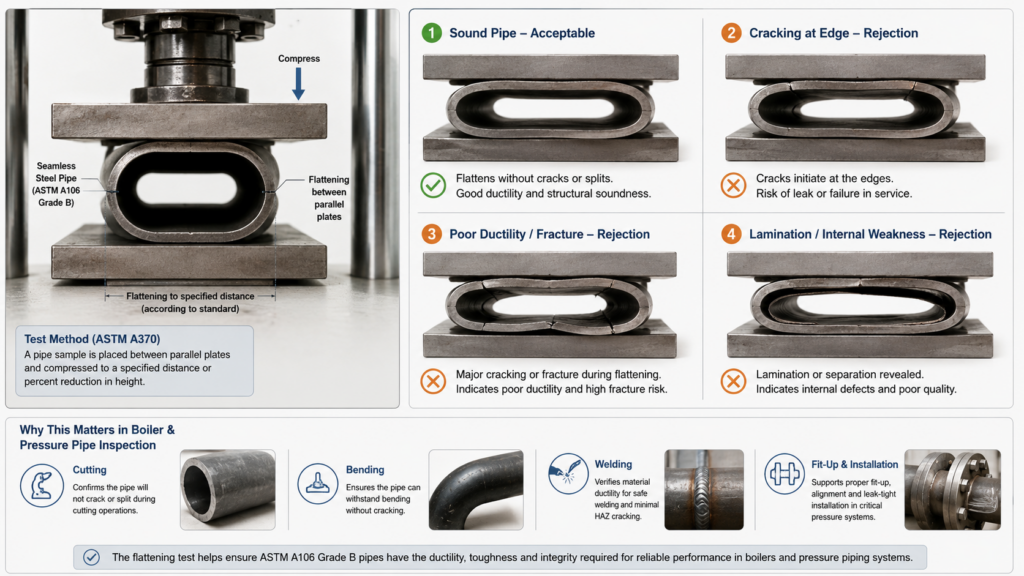
What Does the Flattening Test Reveal?
The flattening test is useful because it shows how the pipe behaves under controlled deformation. It can help reveal cracking, poor ductility, lamination risk, or manufacturing-related weakness.
ASTM’s A106 standard page notes that mechanical testing may include tensile, bend, flattening, hydrostatic, and nondestructive electric tests depending on requirements and edition details. The purpose is not only to confirm numbers, but to see whether the pipe can tolerate forming and service-related stress.
For boiler pipe inspection ASTM A106 Grade B, flattening test results matter because boiler and pressure systems may involve cutting, bending, welding, or fit-up before final installation.
A failed or suspicious flattening result should not be ignored just because the chemistry looks acceptable.
Why Ultrasonic Wall Thickness Measurement Should Not Be Skipped
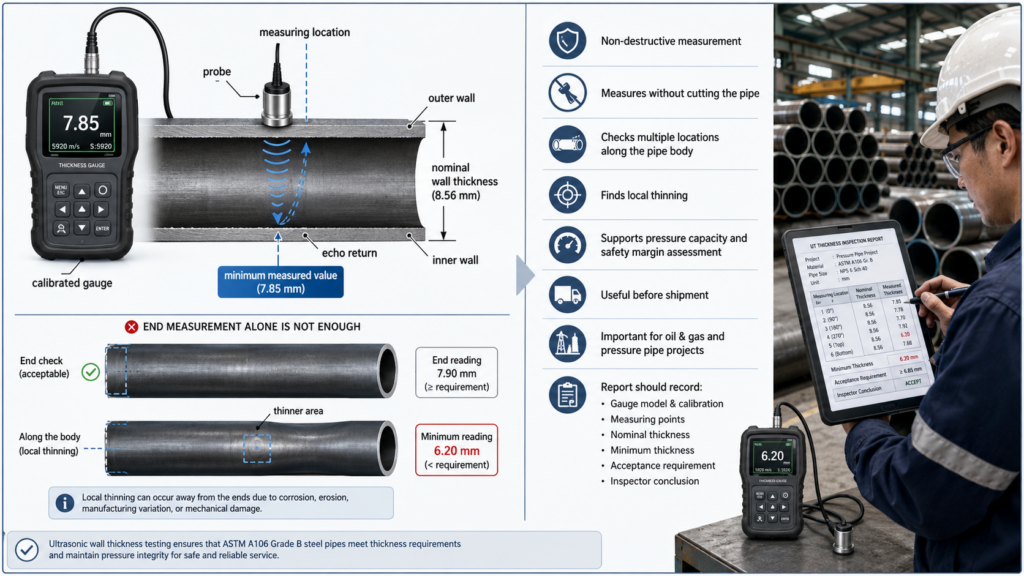
Wall thickness is directly tied to pressure capacity and safety margin.
End measurement alone is not enough. A pipe may look acceptable at the end, while another area along the body is thinner. That is why ultrasonic wall thickness measurement is valuable for steel pipe inspection before shipment.
The NDT Resource Center explains in its section on ultrasonic testing that high-frequency sound energy can be used for examinations and measurements. For pipe wall thickness measurement, this means inspectors can check thickness without cutting the pipe.
For A106 B pipe wall thickness ultrasonic measurement, the report should include:
- gauge model and calibration;
- measuring locations;
- nominal wall thickness;
- minimum measured value;
- acceptance requirement;
- inspector conclusion.
For oil and gas projects, the minimum wall thickness matters more than an average number that hides local thinning.
Which Surface and Dimensional Problems Should Be Caught?
A seamless pipe can still arrive with defects that affect welding, installation, or acceptance.
Inspectors should check:
- cracks;
- pits;
- dents;
- heavy rust;
- deep scratches;
- end damage;
- ovality;
- straightness;
- bevel condition;
- length tolerance.
Dimensional inspection should include outside diameter, wall thickness, length, end condition, and marking. The Engineering ToolBox page on ANSI pipe schedules is useful for understanding how nominal pipe size, outside diameter, and schedule relate to wall thickness during project checks.
This is where third party inspection for A106 B pipe becomes useful. The inspector can compare project requirements, MTC data, pipe marking, and actual measured dimensions before the goods leave the supplier.
What Should a Steel Pipe Inspection Report Include?
A useful report should not be a few photos and a simple “passed” note.
For ASTM A106 Grade B inspection, the report should include:
- purchase order or project reference;
- standard and grade;
- pipe size and quantity;
- heat number;
- MTC review result;
- marking verification;
- visual inspection photos;
- dimensional data;
- hydro test record review;
- flattening test record review;
- ultrasonic wall thickness data;
- non-conformity notes;
- final inspection conclusion.
OSHA’s page on hydrostatic testing hazards also reminds buyers that pressure testing involves stored energy and should be handled with proper safety controls.
What Should Buyers Confirm Before Accepting the Pipe?
Before accepting ASTM A106 Grade B pipe, buyers should confirm more than the grade name.
The MTC must match the pipe. The marking must match the heat number. Hydro test records, flattening test records, wall thickness data, visual condition, dimensions, and packing should all support the same shipment.
That is the practical value of A106 B Pipe Inspection: it helps buyers find document, testing, wall thickness, and traceability problems before those problems become project delays or rejected material.
FAQ
What is A106 B Pipe Inspection?
It is the inspection of ASTM A106 Grade B pipe through MTC review, pipe marking, visual checks, dimensions, wall thickness, hydro test records, flattening test records, and traceability.
Is hydro test required for ASTM A106 Grade B pipe?
It depends on the order, project specification, and applicable standard requirements. Many pressure pipe and boiler projects require hydro test or accepted equivalent testing.
Why is ultrasonic wall thickness measurement important?
Because end-wall checks do not prove the full pipe body is within requirement. UT thickness testing helps find local thin areas before shipment.
What does the flattening test check?
It checks how the pipe behaves under deformation and may reveal cracking, poor ductility, lamination, or manufacturing-related weakness.
How do inspectors verify A106 B pipe MTC?
They compare standard, grade, heat number, size, chemistry, mechanical properties, test records, pipe marking, and actual quantity.
When should buyers arrange third-party inspection?
Before shipment, especially for pressure piping, boiler manufacturing, oil and gas projects, or high-value pipe orders.