
AISI H13 Quality Analysis is not about checking one hardness value and calling the steel acceptable. For die casting dies, extrusion tools, hot forging inserts, and high-temperature tooling, the real question is whether the steel can survive heat, pressure, thermal cycling, and repeated loading without early cracking or softening.
Two blocks can both be sold as AISI H13 / 1.2344, but their performance may be very different. Microstructure, secondary hardening response, internal soundness, inclusion level, and decarburization can decide whether a die runs steadily or fails after costly machining. This guide explains how AISI H13 Quality Analysis helps manufacturers judge material risk before that risk becomes a failed tool.
Table of Contents
Why AISI H13 Quality Analysis Matters Before Machining
For high-end manufacturing, the expensive part is rarely the raw steel alone. The real cost includes rough machining, deep hole drilling, EDM, heat treatment, polishing, nitriding, tryout, downtime, and delayed delivery. If the steel contains hidden defects, poor structure, or weak tempering response, the failure may appear only after much of that cost has already been spent.
A practical quality review does not replace supplier trust. It verifies that the material is suitable for the intended thermal and mechanical load.
Chemical Composition Is Only the Starting Point
A material certificate can confirm that carbon, chromium, molybdenum, vanadium, and silicon are within range. That matters, but it does not fully prove H13 tool steel quality.
AISI H13 Quality Analysis should look beyond chemistry because chemistry cannot show carbide distribution, grain condition, decarburization, inclusions, segregation, or internal defects. It also cannot prove whether the steel will respond properly during quenching and tempering.
This is where many buyers make a costly mistake. They see “AISI H13” or “1.2344” on a certificate and assume performance is guaranteed. In reality, H13 die steel testing must verify the condition of the steel, not only its label.
A useful third-party perspective asks: does this steel have the structure and internal soundness needed for the tool it will become?
Microstructure Analysis: What H13 Looks Like Before Heat Treatment
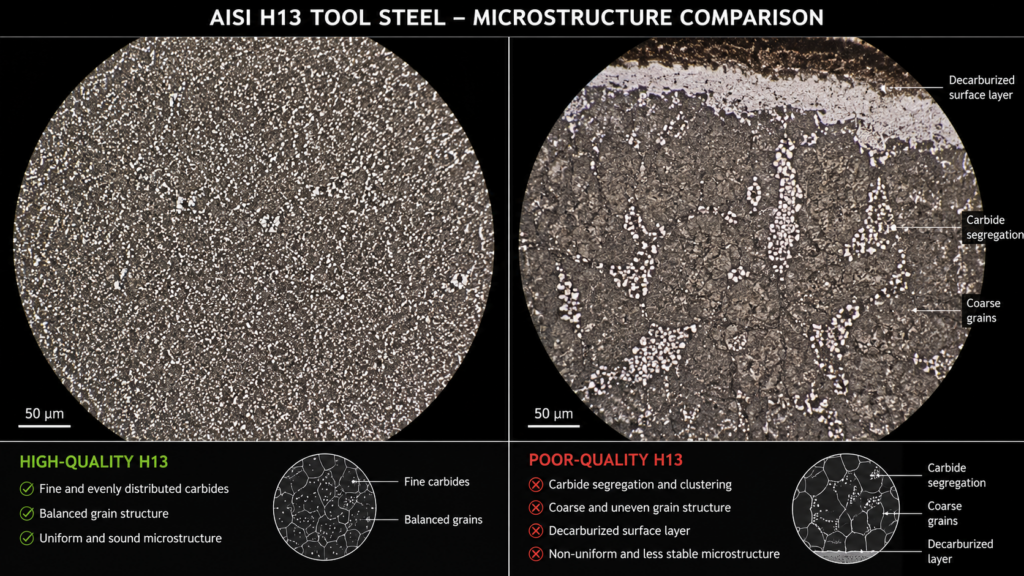
Microstructure is one of the most important parts of AISI H13 Quality Analysis. The steel’s internal structure influences heat treatment response, toughness, thermal fatigue resistance, and machining stability.
A proper microstructure check may review:
- carbide size and distribution;
- grain structure;
- segregation or banding;
- decarburized surface layers;
- annealed condition;
- overheating or abnormal structure;
- inclusion-related features.
For die casting dies, poor microstructure can reduce resistance to heat checking. For extrusion tools, uneven structure can create inconsistent wear, soft spots, or local cracking. AISI H13 Quality Analysis helps identify these risks while the steel is still only material, not yet an expensive die.
Secondary Hardening Test: Why Tempering Response Matters
H13 is a hot-work steel, so its value depends heavily on how it behaves after quenching and tempering. AISI H13 Quality Analysis should include the question: does the steel show a stable secondary hardening response?
A secondary hardening test can compare hardness after different tempering temperatures or cycles. The goal is not simply to reach one hardness number. The goal is to understand whether the batch has a predictable tempering curve and whether it can maintain hardness after thermal exposure.
For die casting molds and extrusion tooling, weak secondary hardening can lead to early softening, deformation, heat checking, or unstable service life. This is why AISI H13 Quality Analysis should evaluate tempering response before high-value machining begins.
Ultrasonic Testing: Finding Hidden Defects Before the Die Is Built
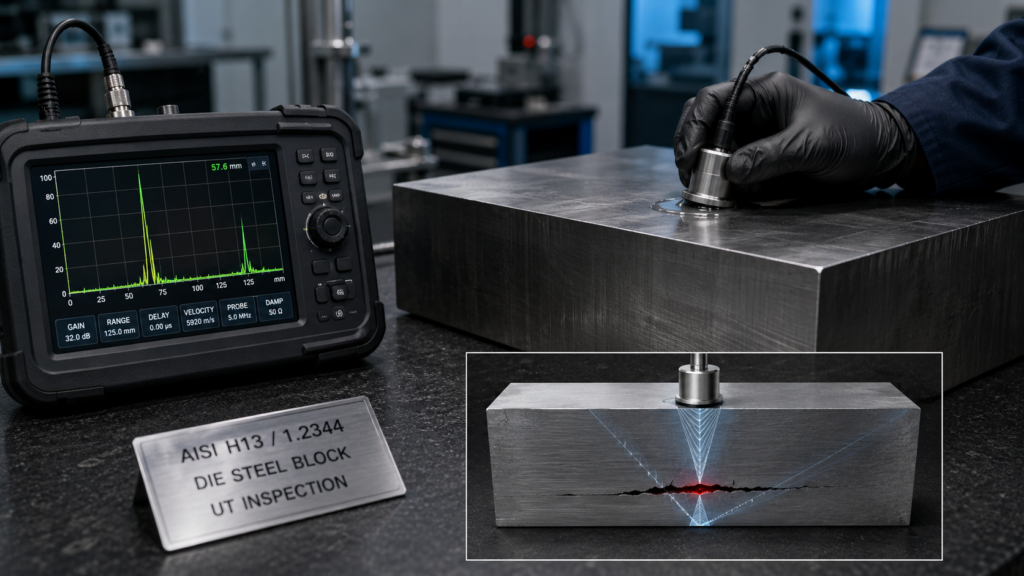
Some quality risks cannot be seen on the surface. Internal cracks, shrinkage, large inclusions, voids, or discontinuities may remain hidden until heat treatment, machining, or service loading.
AISI H13 Quality Analysis should use ultrasonic testing when the steel block is large, the die is expensive, or the application is sensitive to internal soundness. This is especially important for thick die casting blocks, extrusion dies, large inserts, and parts that will undergo deep machining.
Internal defect detection is not just a technical formality. It can prevent wasting machining hours on steel that should never become a production tool.
Inclusion Rating and Cleanliness: Small Defects, Big Consequences
Non-metallic inclusions can affect polishability, fatigue resistance, crack initiation, and machining behavior. In high-pressure die casting and extrusion tooling, inclusions can become weak points under repeated thermal and mechanical stress.
Clean steel does not guarantee perfect die life. But poor cleanliness increases uncertainty. For high-end tooling, uncertainty is expensive.
Common H13 Quality Problems That Lead to Early Die Failure
AISI H13 Quality Analysis is valuable because many early failures have material-related warning signs.
| Quality Issue | Possible Risk in Die Casting or Extrusion Tools |
|---|---|
| Coarse microstructure | Lower toughness and higher cracking risk |
| Carbide segregation | Uneven hardness and inconsistent wear |
| Decarburization | Soft surface and reduced service stability |
| Poor secondary hardening | Early softening under heat |
| Internal cracks | Heat treatment or service failure |
| Large inclusions | Crack initiation or fatigue risk |
| Weak traceability | Harder root-cause investigation |
The point is not to claim every failure comes from the steel. Die design, cooling, heat treatment, nitriding, lubrication, and process control all matter. But AISI H13 Quality Analysis helps separate material risk from process risk.
AISI H13 / 1.2344 Testing for Die Casting Dies
Die casting dies face molten metal, pressure, thermal shock, soldering tendency, erosion, and repeated cooling cycles. For this application, AISI H13 Quality Analysis should focus on thermal fatigue resistance, hardness retention, surface condition, and internal soundness.
A die casting plant does not only need “H13.” It needs H13 that can accept heat treatment, resist heat checking, and remain stable through production cycles.
Useful checks include:
1.chemical composition verification;
2.microstructure analysis;
3.hardness after heat treatment simulation;
4.secondary hardening response;
5.ultrasonic testing;
6.inclusion rating;
7.decarburization check.
This type of H13 die steel testing is especially relevant before producing large cavities, core inserts, and high-value molds.
AISI H13 / 1.2344 Testing for Extrusion Tools
Extrusion tools need strength at temperature, wear resistance, toughness, and stable deformation behavior. AISI H13 Quality Analysis for extrusion tooling should pay close attention to microstructure uniformity and secondary hardening performance.
If the steel softens too early, the tool may lose profile accuracy. If internal defects exist, cracking can occur during heat treatment or under extrusion pressure. If carbide distribution is poor, wear may become uneven.
For aluminum extrusion dies, mandrels, containers, liners, and hot-work tooling, 1.2344 tool steel quality should be reviewed before machining whenever the tool value is high.
When Should Manufacturers Request Third-Party H13 Quality Analysis?
Third-party AISI H13 Quality Analysis makes the most sense when the cost of failure is much higher than the cost of testing.
Consider testing when:
- buying H13 / 1.2344 for high-value dies;
- machining large die blocks;
- switching suppliers;
- qualifying a new batch;
- investigating early die failure;
- comparing premium H13 sources;
- preparing tools for die casting or extrusion;
- heat treatment results have been inconsistent.
What a Practical H13 Quality Report Should Include
A strong AISI H13 Quality Analysis report should be clear enough for engineers, purchasing teams, heat treaters, and tooling managers to use.
It should include:
- material grade and heat number;
- chemical composition;
- hardness condition;
- microstructure photos;
- carbide and grain observations;
- decarburization check;
- inclusion rating;
- secondary hardening or tempering response;
- ultrasonic testing result;
- defect description, if any;
- application-based comments.
The best report does not only say “pass” or “fail.” It explains what the results mean for die casting dies, extrusion tools, and other hot-work applications.
Conclusion
AISI H13 Quality Analysis is not an extra paperwork step. For die casting dies, extrusion tools, and high-value hot-work tooling, it is a way to find material risk before the steel becomes an expensive failure.
By reviewing microstructure, secondary hardening response, inclusion content, ultrasonic testing results, and traceability, manufacturers can make better decisions before machining, heat treatment, or production. AISI H13 Quality Analysis helps turn H13 / 1.2344 from a material label into a verified tooling foundation.
FAQ
What is AISI H13 Quality Analysis?
AISI H13 Quality Analysis is a structured review of H13 / 1.2344 steel quality using tests such as microstructure analysis, hardness verification, secondary hardening evaluation, inclusion rating, and ultrasonic testing.
Why is microstructure important for H13 tool steel?
Microstructure affects toughness, heat treatment response, thermal fatigue resistance, and service stability. Poor microstructure can increase cracking, softening, and uneven wear risk.
What is secondary hardening in H13 steel?
Secondary hardening is the hardness increase or hardness retention caused by alloy carbide precipitation during tempering. It is important for hot-work steel because tools operate at elevated temperatures.
Can ultrasonic testing find defects in H13 die steel?
Yes. Ultrasonic testing can help detect internal discontinuities such as cracks, voids, or large defects that may not be visible on the surface.
Is AISI H13 the same as 1.2344?
AISI H13 and DIN 1.2344 are closely related hot-work tool steel designations. Buyers should still confirm the exact standard, chemistry, heat treatment condition, and quality level.
Why do H13 die casting dies fail early?
Early failure can come from material defects, poor heat treatment, bad die design, thermal fatigue, improper cooling, or process overload. AISI H13 Quality Analysis helps identify material-related risks before production.