
Hardox 500 is often selected for mining machinery, excavator buckets, wear liners, dump bodies, crushers, and other high-abrasion parts. But for buyers and fabricators, the grade name alone is not enough. Before cutting, welding, bending, or installing the plate, the real question is: has the material been properly verified?
This guide explains how to inspect Hardox 500 plate through HBW hardness testing, ultrasonic testing, thickness tolerance checks, and quality document review. The goal is simple: reduce fabrication risk before the plate becomes an expensive wear part.
Table of Contents
Why Hardox 500 Quality Verification Matters Before Fabrication
Wear parts fail for many reasons, but some problems start before the machine ever reaches the jobsite. A plate with the wrong hardness range may wear faster than expected. A plate with internal discontinuities may create problems during cutting, welding, forming, or heavy impact service. A plate with poor thickness control may affect fitting, weld gap, weight distribution, and assembly
For mining equipment and excavator bucket manufacturers, these risks are not small. A failed liner, bucket side plate, or hopper wear plate can cause downtime, repair cost, and customer complaints.
That is why Hardox 500 inspection should not be treated as a formality. It is a practical step before fabrication, especially when the final part will work under abrasive soil, stone, ore, coal, or gravel.
What Hardox 500 Means in Mining and Bucket Applications
Hardox 500 is a wear-resistant steel plate designed for applications where high abrasion resistance is required. According to SSAB’s official Hardox 500 product information, the plate has a nominal hardness of 500 HBW and is commonly used when higher wear resistance is needed.
In real use, Hardox 500 may be found in:
- Excavator bucket liners
- Cutting edges and side wear plates
- Mining truck bodies
- Crusher and screen liners
- Chutes and hoppers
- Conveyor wear components
- Quarry and aggregate equipment
However, harder steel is not automatically better in every condition. Strong impact, improper welding, unsuitable bending, or poor edge preparation can still create failures. A good inspection process helps buyers confirm whether the plate is suitable before it enters production.
Hardox 500 Hardness: Why HBW Testing Comes First
Hardness is usually the first number buyers check. For abrasion-resistant steel, Brinell hardness is closely connected with wear performance. If the hardness is too low, service life may be shorter. If the hardness result is inconsistent, the buyer should investigate before fabrication.
SSAB states that the Brinell hardness test for Hardox 500 is performed according to EN ISO 6506-1, on a milled surface below the plate surface, with at least one test specimen per heat and 40 tons for plate. This gives buyers a reference for how official hardness control is performed.
For field inspection, buyers should avoid testing directly on scale, coating, rough cut edges, or heat-affected zones. A portable hardness tester can be useful, but the test surface must be prepared correctly. One test point is also not enough for a large plate.
Buyer Insight: Hardness testing is not only a number check. It confirms whether the wear plate can deliver the expected abrasion resistance in real mining or bucket service.
Field HBW Testing: Common Mistakes Buyers Should Avoid
On-site hardness testing can go wrong when the method is too casual. This is especially common when buyers use portable equipment without proper surface preparation.
Common mistakes include:
1.Testing over oxide scale or paint
2.Testing too close to a flame-cut edge
3.Testing near weld heat-affected areas
4.Using an uncalibrated portable tester
5.Taking only one reading
6.Ignoring plate thickness and test location
7.Comparing field readings without reviewing the MTC
For Hardox 500 HBW field testing, the result should be compared with the mill test certificate and the agreed specification. If readings vary widely, the buyer should not immediately assume the whole plate is defective. Surface condition, instrument type, operator method, and test location all matter.
Ultrasonic Testing for Hardox 500 Plate: Internal Quality Before Cutting
Hardness tells buyers about surface and material performance, but it does not reveal internal soundness. That is where ultrasonic testing becomes important.
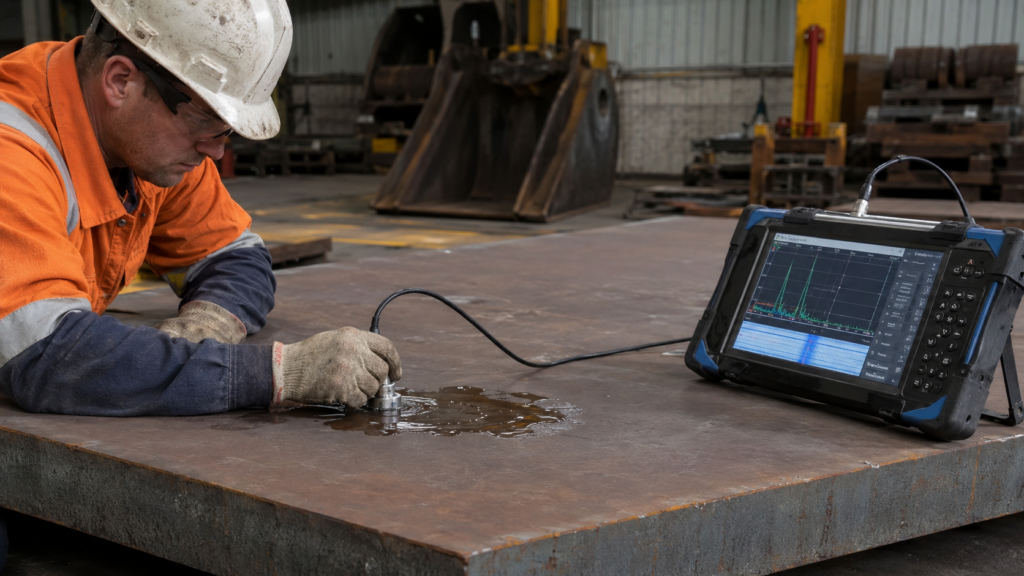
UT inspection can help detect internal discontinuities such as laminations, cracks, inclusions, and other defects that may not be visible from the surface. For thick Hardox 500 plate used in excavator buckets, mining liners, or high-value wear parts, UT can reduce the risk of discovering hidden defects after cutting or welding.
The European standard EN 10160 describes ultrasonic testing of uncoated flat steel products for internal discontinuities and applies to flat steel products within defined thickness ranges. Buyers can use this type of standard as a reference when specifying UT requirements.
UT does not replace hardness testing. It answers a different question: is the plate internally sound enough for the intended fabrication and service condition?
Thickness Tolerance: Small Deviations Can Affect Buckets and Wear Liners
Thickness tolerance is often overlooked, but it can directly affect fabrication quality. For excavator bucket liners, side plates, bottom plates, and wear strips, thickness variation can change weight, fit-up, bending results, weld gap, and final assembly accuracy.
A few millimeters may not look serious on paper. But in a bucket structure, uneven plate thickness may affect how parts align during welding. In wear liners, it may change service life expectations or cause installation difficulty.
When ordering Hardox 500, buyers should confirm:
- Nominal thickness
- Accepted tolerance
- Measurement method
- Flatness requirement
- Cutting size tolerance
- Whether thickness values are included in inspection documents
SSAB’s Hardox downloads and technical documents include workshop and delivery information that buyers can review when planning fabrication, cutting, bending, or welding.
Quality Documents Buyers Should Request
A plate inspection is stronger when it is supported by traceable documents. Before fabrication, buyers should request and review:
- Mill Test Certificate
- Heat number
- Steel grade and specification
- Chemical composition
- Hardness test result
- Plate dimensions
- Thickness tolerance statement
- UT report, if required
- Surface inspection result
- Delivery and marking records
A proper MTC helps connect the delivered plate to its heat number and test results. Without traceability, quality claims become difficult. For high-value applications, documents are not paperwork; they are part of risk control.
Hardox 500 for Excavator Buckets: What Fabricators Should Watch
Excavator buckets face mixed wear conditions. The bottom plate may see sliding abrasion, side plates may experience side wear, and cutting zones may face both impact and abrasion. That means material choice should match the component position.
Hardox 500 for excavator bucket applications can be useful where abrasive wear is dominant, but fabricators must manage cutting edges, weld procedures, bending radius, and heat input. SSAB’s thermal cutting recommendations for Hardox wear plate explain that Hardox grades can be cut by thermal methods such as oxy-fuel, plasma, and laser, as well as cold cutting methods such as abrasive water jet and sawing.
The practical point is clear: Hardox 500 plate quality should be verified before fabrication, and fabrication procedures should also match the grade.
Hardox 500 for Mining Equipment: Inspection Can Save Cost
In mining equipment, downtime is often more expensive than the material itself. Chutes, hoppers, liners, truck bodies, and crusher-related wear parts operate in harsh abrasive environments. If the plate is not checked before fabrication, quality problems may appear only after installation.
A basic inspection workflow can include:
- Confirming grade and heat number
- Reviewing MTC and hardness data
- Performing multi-point thickness checks
- Requesting UT for critical plates
- Inspecting surface defects before cutting
- Keeping records for future claims or repeat orders
A supplier that can support this process provides more value than one that only offers stock availability.
How to Choose a Supplier for Tested Hardox 500 Plate
For high-wear applications, the best supplier is not only the one with inventory. It is the one that can support verification before fabrication.
plate options, quality documents, hardness testing support, UT inspection if required, thickness measurement, cutting service, and application-based communication.
A useful supplier should understand mining machinery, excavator buckets, wear liners, and downstream fabrication requirements. If a buyer only receives a price and a plate photo, that is not enough for a critical wear part project.
Conclusion
Hardox 500 should not be selected only by grade name or price. For mining machinery, excavator buckets, liners, and other high-wear components, buyers should verify hardness, internal quality, thickness tolerance, traceability documents, and fabrication requirements before production begins.
A strong inspection process helps reduce wear part failure risk, avoid fabrication surprises, and protect long-term equipment performance. When Hardox 500 is properly verified and matched to the application, it can become a more reliable material choice for demanding abrasion environments.
FAQ
What is the hardness of Hardox 500?
Hardox 500 has a nominal hardness of about 500 HBW. Buyers should check the MTC and agreed hardness range for the actual delivered plate.
How should Hardox 500 hardness be tested?
Brinell hardness testing is commonly used. For field checks, the surface should be properly prepared and readings should be compared with the MTC.
Does Hardox 500 need ultrasonic testing?
UT is not required for every order, but it is recommended for thick plates, critical wear parts, excavator buckets, and mining equipment components.
Why does thickness tolerance matter?
Thickness affects fitting, welding gap, weight, bending accuracy, liner installation, and final component performance.
Can Hardox 500 be welded?
Yes, but welding should follow recommended procedures for abrasion-resistant steel, including proper consumables, heat input control, and preheating when required.
Is Hardox 500 always better than Hardox 450?
Not always. Hardox 500 has higher hardness, but the better choice depends on wear type, impact level, fabrication method, and component design.