
Table of Contents
Introduction

Steel is one of the most widely used materials in construction, automotive, and industrial applications. Even small deviations in chemical composition or mechanical properties can lead to structural failures or costly recalls. Steel testing is the cornerstone of quality assurance, allowing manufacturers, buyers, and engineers to confirm that steel meets the required specifications.
At Shandong Laboratory, a professional third-party metal testing facility, we provide comprehensive steel testing services. Our experienced engineers combine advanced equipment with rigorous quality control to ensure accurate and reliable results. This guide covers the major testing methods, standards, and considerations to help you make informed decisions.
Types of Steel Testing
Chemical Composition Testing
Purpose: Verify the elements in steel to confirm the correct grade and predict performance.
Commonly measured elements:
- Carbon (C)
- Manganese (Mn)
- Silicon (Si)
- Chromium (Cr)
- Nickel (Ni)
- Molybdenum (Mo)
- Phosphorus (P) & Sulfur (S) (for impurity control)
Methods:
- Optical Emission Spectrometry (OES)—Provides precise elemental analysis, suitable for carbon steels, stainless steels, and alloys.
- X-ray Fluorescence (XRF)—Quick, non-destructive testing for alloy verification and harmful substance screening.
Why it matters: Accurate chemical composition is critical for welding, machining, corrosion resistance, and mechanical properties.
Mechanical Property Testing
Purpose: Determine steel’s strength, ductility, and toughness to meet design requirements.
Key tests:
- Tensile Testing: Measures yield strength, ultimate tensile strength, and elongation.
- Hardness Testing (Rockwell, Brinell, Vickers): Evaluates resistance to surface deformation and wear.
- Impact Testing (Charpy): Assesses toughness under sudden forces or low temperatures.
Comparison Table: Mechanical vs Hardness vs Impact Testing
| Test Type | Property Measured | Suitable For | Destructive? |
|---|---|---|---|
| Tensile Testing | Strength, elongation | Structural steel, rods | Yes |
| Hardness Testing | Surface hardness, wear resistance | Tools, coatings | Minimal |
| Impact Testing | Toughness under impact | Automotive, pipelines | Yes |
Non-Destructive Testing (NDT)
Purpose: Detect surface or internal flaws without damaging the steel.
Common methods:
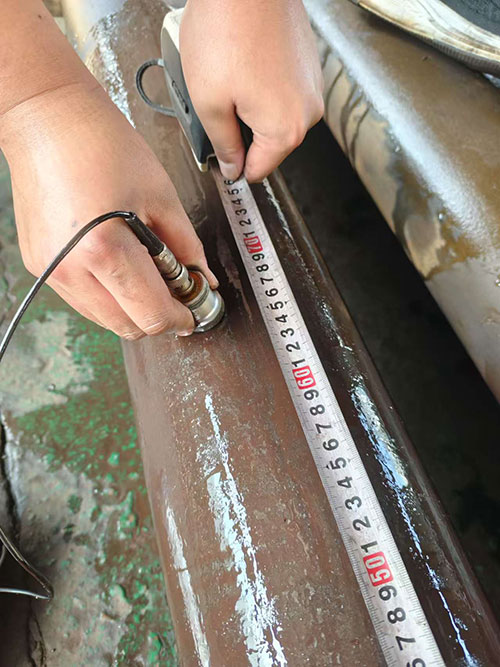
- Ultrasonic Testing (UT): Finds internal cracks, voids, or delamination.
- Magnetic Particle Testing (MT): Reveals surface and near-surface cracks in ferromagnetic steels.
- Dye Penetrant Testing (PT): Detects fine surface cracks.
- Radiographic Testing (RT/X-ray): Inspects welds and internal defects.
Why NDT is critical: It ensures reliability for high-risk components like pressure vessels, pipelines, and critical structural steel without destroying the product.
Dimensional & Visual Inspection
Purpose: Ensure steel components meet design specifications and assembly requirements.
Key steps:
- Verify dimensions with calipers, micrometers, and coordinate measuring machines (CMM).
- Inspect surface quality for rust, scratches, dents, cracks, and welding spatter.
- Assess coatings and finishes for uniformity, color consistency, and adhesion.
- Evaluate assembly and workmanship, including threaded connections and movable parts.
Comparison: Laboratory vs On-Site Inspection
| Aspect | Laboratory Testing | On-Site Inspection |
|---|---|---|
| Equipment | Full spectrum machines (OES, UT, CMM) | Portable gauges and spectrometers |
| Precision | Very high | Moderate |
| Time | Longer, batch-based | Immediate, real-time |
| Use Case | Certification, detailed analysis | Pre-delivery check, QA oversight |
Corrosion & Coating Testing
Purpose: Ensure steel can resist environmental damage and maintain performance.
Common tests:
- Salt Spray Test (ASTM B117): Simulates corrosive conditions.
- Coating Thickness Measurement: Ensures paint, galvanization, or other coatings meet requirements.
- Intergranular Corrosion Test: Evaluates susceptibility in stainless steels.
Why it matters: Corrosion resistance directly affects product longevity and maintenance costs.
Steel Standards & Compliance
Standards commonly referenced in steel testing:
- ASTM (American Society for Testing and Materials)
- ISO (International Organization for Standardization)
- EN (European Norms)
- GB/T (Chinese National Standards)
Key considerations:
- Verify chemical and mechanical properties against grade specifications.
- Ensure traceability from batch number to Material Test Report (MTR).
- Understand variations between international standards (e.g., ASTM vs EN tensile requirements).
Lab Quality Control in Steel Testing
Ensuring test reliability through:
- Sample Chain Management (CoC): Barcode tracking from client to lab.
- Equipment Calibration: UT, OES, and tensile machines are calibrated regularly.
- Data Integrity: LIMS systems and electronic signatures ensure results are traceable.
- Capacity Verification: Participation in proficiency testing and inter-lab comparisons.
Common Challenges in Steel Testing
- Identifying small cracks or surface flaws before shipment.
- Variability in chemical composition between batches.
- Balancing speed and accuracy for large shipments.
- Ensuring representative sampling, especially for heterogeneous materials.
- Interpreting mechanical property results for different steel grades.
Case Studies: Real-World Applications

- Example 1: Stainless steel rods inspected with OES confirmed correct Ni and Cr content, preventing welding failures.
- Example 2: Pre-shipment dimensional inspection of forged parts identified minor deviation in key dimensions, avoiding costly installation rework.
- Example 3: UT detected hidden voids in structural steel beams, ensuring safety before assembly.
Choosing the Right Steel Testing Partner
Factors to consider:
- ISO 17025 accreditation ensures reliable results.
- Experience with the steel grades and products you source.
- Capability for both destructive and nondestructive testing.
- Digital reporting and real-time progress tracking.
- Independent, third-party verification for unbiased results.
Conclusion
Steel testing is critical to ensure quality, safety, and regulatory compliance. By combining chemical analysis, mechanical testing, nondestructive inspection, and dimensional checks, manufacturers and buyers can avoid costly errors and ensure performance. Working with an accredited third-party lab like Shandong Laboratory guarantees accurate, impartial, and traceable results.
Contact us today to schedule a steel testing service tailored to your materials and requirements. Protect your investment and make informed decisions with reliable steel testing.
FAQ
What types of steel require chemical composition testing?
Any steel where performance depends on specific elements, such as stainless steel (Cr, Ni, Mo) or alloy steel (Mn, Si, C), requires chemical testing to ensure reliability.
How do I know if a mechanical property test is necessary?
If the steel will bear structural loads, impact, or wear, tensile, hardness, and impact tests are recommended.
Can steel testing be performed on-site?
Yes, portable XRF, hardness testers, and some dimensional checks can be performed on-site, but full mechanical tests usually require a lab.
How accurate are nondestructive tests like UT and PT?
Highly accurate for detecting flaws, but effectiveness depends on inspector expertise, equipment calibration, and access to critical areas.
How do I choose between laboratory and on-site steel testing?
Use on-site for rapid verification and pre-delivery checks. Use laboratory testing for certification, precise chemical analysis, and destructive mechanical testing.