
Welcome to My Blog!
Before we dive into the content, if you’re interested in our products or have any questions, please feel free to visit our Contact Us page on the website. Our team is ready to assist you with inquiries, orders, or any support you may need.
Now, let’s get started on our journey together. I hope you find the content here insightful, engaging, and valuable.
Table of Contents
Introduction
In the world of modern manufacturing, precision defines success. Every high-performing product—from automotive parts to construction materials—depends on one crucial step: accurate inspection tools. These instruments ensure that every component meets strict specifications, safety standards, and customer expectations. But what exactly are testing tools, and how do they impact quality control?
This article provides a comprehensive overview of inspection tools, including their types, applications, selection criteria, and future trends. Drawing on decades of industrial experience and technical expertise, it explores how the right testing tool can make the difference between excellence and error.
What Is an Inspection Tool and Why It Matters
An inspection tool is any device or equipment used to examine, measure, or verify the quality of a product or material. From dimensional accuracy to surface finish and chemical composition, testing tools serve as the first line of defense against defects.
In manufacturing and engineering, these tools are critical for:
- Ensuring compliance with design drawings and tolerances
- Preventing costly rework and recalls
- Maintaining consistency in large-scale production
- Verifying supplier quality before shipment
According to a 2023 report by the International Organization for Standardization (ISO), over 65% of industrial quality failures originate from improper or insufficient inspection methods. That statistic alone underscores the importance of choosing the right inspection tool for every task.
Types of Inspection Tools and Their Applications

Dimensional Inspection Tools
Dimensional testing tools measure the physical size, geometry, and alignment of a part.
Common examples include:
- Vernier calipers and micrometers—for measuring thickness, diameters, and depths
- Height gauges and coordinate measuring machines (CMMs)—for complex shapes and precise tolerances
- Dial indicators—to detect flatness or concentricity deviations
Application areas: Metal fabrication, machining, and component assembly industries.
Visual Testing Tools
Visual inspection is the oldest and most widely used quality control method. Modern testing tools combine optics with digital imaging for higher accuracy.
Typical visual inspection tools include:
- Magnifying glasses and microscopes for micro-crack detection
- Borescopes and endoscopes for internal cavity inspections
- Portable LED lamps and magnifiers for surface evaluation
Purpose: Detect surface flaws such as cracks, scratches, dents, corrosion, or weld imperfections.
Non-Destructive Testing (NDT) Inspection Tools
Non-destructive testing tools assess internal integrity without damaging the part. They are essential for safety-critical industries like aerospace and heavy machinery.
Examples:
- Ultrasonic flaw detectors
- X-ray and radiographic systems
- Magnetic particle testers
- Dye penetrant kits
Key advantage: NDT tools identify hidden flaws—such as porosity, internal cracks, or delamination—before they cause failures.
Material Composition and Elemental Inspection Tools
Understanding a material’s elemental composition is vital for ensuring the right alloy, hardness, and strength.
Commonly used inspection tools include
- X-ray Fluorescence (XRF) analyzers
- Optical Emission Spectrometers (OES)
- Portable chemical analyzers
These tools measure the presence and percentage of elements such as
- Carbon (C)
- Silicon (Si)
- Manganese (Mn)
- Chromium (Cr)
- Nickel (Ni)
- Molybdenum (Mo)
Each element directly affects properties like corrosion resistance, ductility, and tensile strength.
Surface and Coating Testing Tools
Surface quality plays a key role in aesthetics, corrosion resistance, and performance.
Key surface inspection tools include:
- Coating thickness gauges
- Adhesion testers
- Gloss meters
- Roughness testers
These inspection tools help manufacturers verify whether surface treatments, such as painting, plating, or anodizing, meet specifications.
Key Elements Measured by Inspection Tools
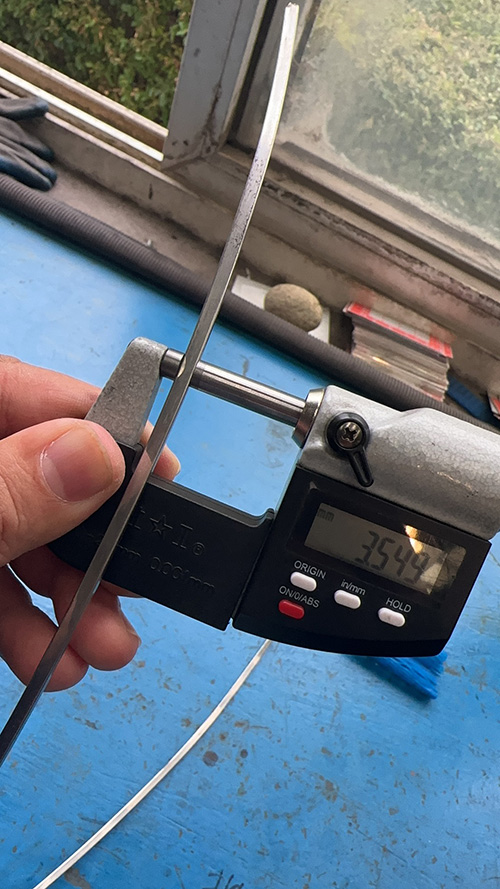
Inspection tools evaluate critical aspects that define product quality:
- Dimensional accuracy—length, angle, and thickness
- Surface integrity—scratches, coating, and roughness
- Material composition—elemental and chemical properties
- Mechanical performance—hardness, tensile strength, and flexibility
Accurate measurement of these elements ensures that materials comply with international standards like ISO, ASTM, and DIN.
Manual vs. Digital Testing Tools: A Practical Comparison
| Feature | Manual Tools | Digital Tools |
|---|---|---|
| Accuracy | Moderate | High |
| Ease of Use | Requires skill | User-friendly |
| Data Recording | Manual | Automatic storage |
| Cost | Lower | Higher |
| Example | Vernier caliper | Digital micrometer |
Insight:
Digital inspection tools offer faster, more consistent readings with integrated data management. However, manual tools remain cost-effective for low-volume or field inspections. A combination of both often delivers the best results.
Choosing the Right Inspection Tool

Factors to Consider
When selecting an inspection tool, consider:
- Type of material (metal, polymer, composite)
- Required precision (tolerance limits and measurement uncertainty)
- Inspection environment (factory floor vs. laboratory)
- Budget and volume
- Standard compliance (ISO 9001, ISO 17025, ASTM E18, etc.)
Expert Support for Accurate Results
Working with an accredited testing partner ensures that testing tools are properly calibrated and applied. At Shandong Laboratory, our experts use certified instruments to deliver reliable, traceable, and unbiased results.
Best Practices for Using and Maintaining Testing Tools
Calibration and Verification
Regular calibration guarantees accuracy and traceability. Use certified reference blocks or master gauges to verify readings.
Proper Handling and Storage
Avoid moisture, dust, and physical shocks. After every use, clean and store tools in controlled conditions to prevent degradation.
Operator Competence
Even the best testing tool can yield false results in untrained hands. Continuous skill training ensures precision and consistency.
Future Trends in Inspection Tools
The next generation of testing tools integrates AI-driven image analysis, IoT connectivity, and cloud data management. Automated inspection systems are already reducing human error and accelerating quality checks in smart factories.
Emerging trends include:
- Real-time defect recognition using computer vision
- Wireless sensor networks for remote monitoring
- Predictive maintenance powered by inspection data analytics
According to a 2024 survey by Quality Magazine, over 70% of manufacturers plan to integrate smart inspection tools by 2026, highlighting a strong shift toward digital transformation.
Conclusion
Inspection tools are the backbone of every quality assurance system. Whether it’s checking dimensions, analyzing materials, or verifying coatings, the right tools safeguard performance, safety, and customer trust.
By investing in accurate, well-calibrated testing tools—and partnering with experienced professionals—you can reduce defects, boost efficiency, and maintain consistent quality across every batch.
FAQ
What is an inspection tool used for?
It’s used to measure, evaluate, and verify product quality during or after manufacturing to ensure compliance with required standards.
What are examples of common inspection tools?
Calipers, micrometers, XRF analyzers, ultrasonic testers, and coating thickness gauges are widely used.
What’s the difference between destructive and non-destructive inspection tools?
Destructive tools damage samples to test properties, while nondestructive tools assess internal or surface flaws without harming the part.
How often should testing tools be calibrated?
Typically every 6 to 12 months, depending on frequency of use, accuracy requirements, and environmental factors.
Can digital testing tools completely replace manual ones?
Not entirely. Manual tools remain practical for low-cost or on-site applications, while digital ones are preferred for high-precision production.