
Picture this scenario: concrete has been poured up to the tenth floor of a thirty-story building. Then, a delayed test report reveals that a batch of critical structural steel, delivered weeks earlier, fails to meet the design-specified grade.
What does this mean? It goes far beyond replacing a single component. It entails partial demolition of completed floors, months of schedule delays, and financial losses running into millions.
This nerve-wracking hypothetical reveals a truth often overlooked: the absolute safety of a building begins with absolute trust in every piece of steel. The only way to build this trust is through systematic and rigorous Steel Testing in Construction.
This foundational process is not a mere cost—it is the most critical investment in risk control and quality assurance for project managers, defining the very essence of professional Steel Testing in Construction.
Table of Contents
Beyond Code Compliance: Why On-Site Testing is an Indispensable Management Tool
Many view material testing as a passive act to satisfy code paragraphs. This is a fundamental misconception. On a construction site, it is first and foremost an active risk management tool. Its core value lies in accurately identifying and intercepting problems before they escalate into disasters or exorbitant costs.
Construction steel travels a long supply chain from smelting to installation. Deviations at any stage—whether slight fluctuations in chemical composition or internal defects from rolling—can remain latent. Steel Testing in Construction acts like a round-the-clock sentry, conducting checks at every pass: material arrival, fabrication, and installation. It provides project managers with objective, data-driven decision-making power, turning “we think it’s okay” into “the data proves it’s safe.”
A Field Guide: Four Core Testing Methods That Determine Project Success
On a busy site, the theory behind Steel Testing in Construction must translate into actionable steps. Here are four proven, core on-site methods that directly impact structural safety and define rigorous practice.
Method 1: Witnessed Sampling & Mechanical Testing – The Material’s “Identity Verification”
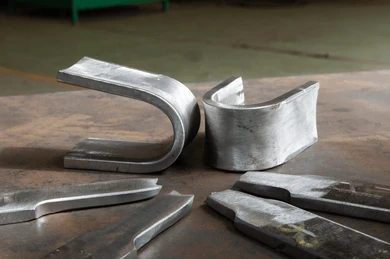
This is the cornerstone of all testing. When a batch of steel arrives on-site, the supervisor or a third-party inspector randomly selects samples according to code and sends them to a laboratory.
- What it does: Subjects samples to tensile, bend, and impact tests to obtain key data like yield strength, ultimate tensile strength, and elongation.
- What it solves: This is the only authoritative method to determine the true grade of the steel. It completely prevents the fraudulent substitution of lower-grade for higher-grade material, ensuring structural calculations are based on real material properties. This phase of Steel Testing in Construction is the first and most crucial firewall against systemic risk.
Method 2: Ultrasonic Testing – The “Internal CT Scan” for Welds
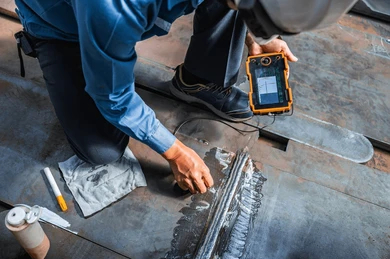
In steel frames, the connecting welds between beams and columns are lifelines for force transfer. Ultrasonic Testing is the preferred method for assessing their internal quality.
- What it does: Technicians use a portable unit to send high-frequency sound waves into the weld. By analyzing the reflected signals, they can precisely locate internal defects like porosity, slag inclusions, or lack of fusion.
- What it solves: Ensures the integrity of critical load-bearing welds, achieving the “equal-strength connection” required by design. For key welds in core wall nodes of high-rises or critical trusses of long-span structures, this form of Steel Testing in Construction is the non-destructive verification method guaranteeing structural integrity.
Method 3: Magnetic Particle Testing – The “Developer” for Surface Cracks
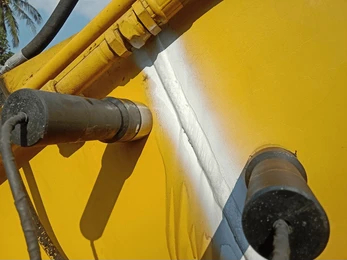
Many failures begin at the surface. Magnetic Particle Testing is the fastest, most economical method for detecting fine cracks in steel and welds.
- What it does: The area under inspection is magnetized, and iron particles are applied. Any surface or near-surface discontinuity (like a crack) attracts the particles, forming a visible indication.
- What it solves: Efficiently screens for micro-cracks caused by welding stress, material hardening, or fatigue. Performing this check before component lifting or significant load application can prevent crack propagation under stress, constituting a preventive form of Steel Testing in Construction.
Method 4: High-Strength Bolt Torque Inspection – The “Pressure Gauge” for Connection Safety
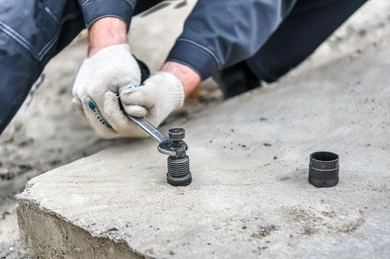
Modern steel structures rely heavily on high-strength bolted connections. Their reliability hinges entirely on achieving the designed clamping force during installation.
- What it does: Uses a calibrated torque wrench to perform sampled or full checks on installed bolts, verifying their final torque value.
- What it solves: Ensures the bolt group provides sufficient frictional resistance to prevent joint slippage under wind or seismic loads. Insufficient torque is a common cause of steel frame joint failure. This specific Steel Testing in Construction for connections directly safeguards the structure’s stiffness and stability.
Full-Process Control: Embedding Testing into Key Project Lifecycle Milestones
Effective Steel Testing in Construction is not a one-off event but a continuous process integrated throughout the project. It must be rigorously enforced at these key milestones:
- Milestone A: Material Delivery & Acceptance: Strictly enforce the “witnessed sampling” protocol. Reject non-compliant materials outright, eliminating hazards at the source.
- Milestone B: Factory Prefabrication Monitoring: Complete NDT on primary welds of large, complex prefabricated components before they leave the shop, solving problems upfront.
- Milestone C: On-Site Installation Surveillance: Establish the principle that “the next trade can only begin after testing of the previous work passes.” Implement high-percentage sampling or 100% testing for site welds and bolted connections.
- Milestone D: Completion & Documentation: Consolidate all test reports into a complete “Material Quality Dossier.” This provides irreplaceable baseline data for future maintenance, modifications, or safety assessments.
Selecting Your Testing Partner: Three Non-Negotiable Criteria
Choosing who performs your Steel Testing in Construction is as critical as selecting your designer or general contractor. Evaluate potential partners against these three core criteria:
1.Depth of Qualifications & Experience: Testing personnel must hold certifications from national or international accredited bodies (e.g., UT, MT Level II or III). More importantly, they should have hands-on experience with similarly complex projects (like skyscrapers or long-span structures) and be able to handle real-world site challenges.
2.Reliability of Equipment & Technology: The provider should use advanced, regularly calibrated equipment. They must offer testing solutions adaptable to harsh site conditions: heights, confined spaces, and temperature extremes.
3.Authority & Responsiveness of Reporting: An excellent test report is clear, standardized, conclusive, and delivered promptly. A superior service provider can offer preliminary findings on-site and produce a legally valid formal report within 24 hours, ready for project archiving and approval.
Reliable Buildings Begin with Respect for Every Piece of Steel
A building’s essence is to be a space that hosts human activity and trust. This profound trust is ultimately redeemed by the reliable performance of thousands of tons of steel. Rigorous, scientific, and continuous Steel Testing in Construction serves as the essential discipline that validates this performance. It is the final and most critical process, the definitive Steel Testing in Construction protocol that translates safety factors on blueprints into absolute safety in the physical world.